
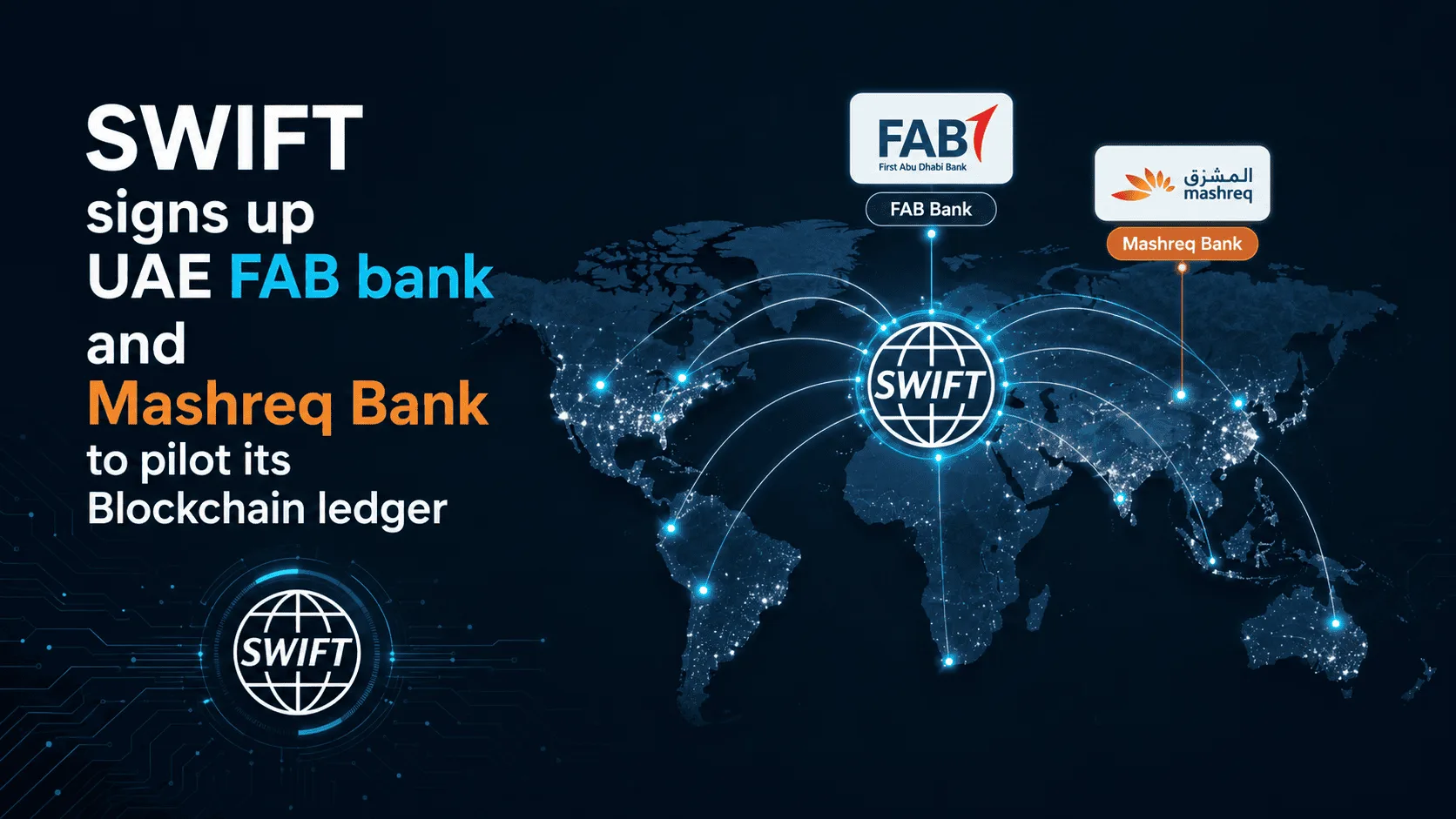
Swift signs up 17 banks from six continents to try out its blockchain based ledger including First Abu Dhabi bank and Mashreq Bank in UAE. Banks will be able to explore 24/7 cross border payments with tokenized deposits. The banks will pilot live transactions reflecting strong global demand for the new addition to Swift’s technology stack and its ability to unlock faster, flexible money movement across the world.
When SWIFT first announced its Blockchain settlement project, UAE based Emirates NBD, and First Abu Dhabi Bank, as well as Saudi Awwal Bank (SAB) were part of 30 financial institutions participating.
The 17 banks are ANZ, BNP Paribas, BNY, Citi, DBS, First Abu Dhabi Bank (FAB), FirstRand Bank Limited, HSBC, Itaú Unibanco, Lloyds Bank, Mashreq, MUFG Bank, OCBC, Standard Chartered, UBS, UOB and Wells Fargo.
The shared ledger provides participating banks with a secure orchestration layer for bank-issued tokenized deposits on their own ledgers, enabling them to move funds for customers, including overnight and on weekends, before completing final settlement through existing systems.
As per the press release, banks benefit from improved client experience and global liquidity efficiency without compromising compliance, credit, risk and control standards embedded in existing payment processing.
Thierry Chilosi, Chief Business Officer at Swift, noted that the new blockchain ledger extends trust and stability of established finance into the frontiers of digital money. He adds, ” It allows tokenized value to move across borders with the velocity and flexibility modern commerce expects, while maintaining the same high levels of resiliency, security, and compliance global finance requires.
The strong support from banks shows the practical value of this approach, one that will help scale benefits globally while creating a foundation for future innovation in areas like programmable money and agentic commerce.”
The ledger, which will expand in functionality and availability after the initial controlled go-live phase, builds upon improvements already made by Swift and its community to existing rails.
Joel Van Dusen, Group Head of Corporate and Investment Banking at Mashreq, noted “Mashreq is committed to shaping the future of financial services through innovation in digital banking. By collaborating with Swift to utilize next generation ledger technologies, we will enable faster settlement and enhance the security of transaction processing for our clients.”
According to Mazen Pharaon, a Saudi based digital economy expert leading a stealth startup, on a LinkedIn post, noted that ” It is not simply that Swift is using blockchain. It is the architecture being created around it. Swift is not issuing its own digital currency or asking banks to abandon their existing infrastructure. Each participating bank retains its own tokenized deposits and its established compliance, credit, risk and control processes.”
He adds, ” Swift provides the shared orchestration layer that enables these different bank-issued forms of digital money to interoperate. Final settlement still takes place through existing banking systems. This is therefore not yet universal, fully on-chain, instant settlement at global scale. It is a controlled live-pilot phase—but it is materially beyond another laboratory prototype.”
Prior to this in November 2025, two UAE Banks, Emirates NBD and First Abu Dhabi Bank participated in the testnet for Circle Internet Group’s for Arc, an open Layer-1 blockchain network designed to meet the needs of developers and companies bringing more economic activity onchain. Circle launched Arc in October 2025, with a global collaboration of 100 companies across the financial and economic ecosystem. Arc is now available for developers and enterprises to deploy, test and build on what Circle describes as the new Economic Operating System (“OS”) for the internet.