CoreWeave’s stock has fallen about 24% since October 9 as investors reassess the AI cloud provider’s debt burden and financing costs. The concerns intensified on October 20 after South Korea’s Elice Group fell 32% on its stock market debut, adding to questions about valuations and returns across the AI infrastructure sector. Reuters described Elice’s decline as the worst debut in South Korea for a company that raised more than $100 million in an IPO. The KOSPI fell 3.73% to its lowest close since April 7. In the US, trading was mixed: IREN, Cipher Digital and WhiteFiber ended lower, while Nebius and CoreWeave closed higher.
CoreWeave's debt pressure
CoreWeave’s sell-off began before Elice’s IPO. Its shares fell 15.46% on October 14 amid rising bond yields, then declined another 11.91% on October 16 to close at $61.39. According to CNBC, the yield to maturity on CoreWeave’s 9.625% bond due 2032 reached 14.8% on October 14, while its 9.75% bond due 2031 yielded around 14.9%. By October 15, the 2031 bond’s yield had climbed to 15.78%, and the spread on the company’s five-year credit default swaps briefly exceeded 1,140 basis points, a level associated with severe credit concerns. S&P Global Ratings rates CoreWeave B+, below investment grade, while CNBC reported that its debt and obligations exceeded $51 billion.
CoreWeave's own results show the squeeze. In the second quarter, it reported revenue of $2.58 billion, up 112% year over year, and a revenue backlog of about $104 billion at June 30. Net interest expense of $640 million still exceeded adjusted operating income of $128 million, and the company posted a GAAP operating loss of $49 million and a net loss of $626 million. CoreWeave says it is confident that its backlog more than supports all of its debt obligations, and the market is now weighing that backlog against the cost of financing it.
Analysts are split. HSBC rates CoreWeave Reduce with a $39 price target, citing debt-market concerns and moderating revenue growth among large language model developers, according to CNBC. Goldman Sachs takes the opposite view: it upgraded the stock to Buy on October 19 and raised its price target from $106 to $139. Despite the upgrade, shares closed that session down 0.44% at $61.12.
What happened in Seoul
Elice provides AI cloud services as well as AI-based education and business software. It raised 201.1 billion won ($150 million) in its IPO and plans to spend most of the proceeds on portable modular data centers and related infrastructure. The offering was priced on October 6 at 90,500 won a share, before the recent sell-off in AI stocks. The stock closed its first session at 60,500 won, valuing the company at approximately 674 billion won ($508 million), according to Reuters.
The debut contrasts sharply with demand at pricing. Institutional orders were 388.84 times the shares on offer, yet the stock still ended far below its offer price. Elice's business also showed growth: first-half revenue tripled to 34 billion won, while operating profit reached 10 billion won, compared with a 3.5 billion won loss a year earlier. A crowded order book does not guarantee buyers once trading opens in a cautious market.
On October 21, Elice shares rebounded approximately 30% in their second trading session, although they remained below their IPO price. The sharp reversal highlights the volatility surrounding investor sentiment toward AI infrastructure companies.
Why investors are reassessing AI infrastructure
Elice's IPO is small, but investors read it as a signal on appetite for AI capital spending. Swissquote analyst Ipek Ozkardeskaya calls the timing bad and the debut a warning for upcoming AI listings. Other deals are already slipping: the IPO of Nvidia-backed Firmus in Australia was shelved, Blackstone-backed AirTrunk postponed a Singapore listing, and SB Energy, a SoftBank unit, delayed its US share sale. Ke Yan of Shenton Research says investors now focus on customer contracts and committed revenue.
Financing costs add to the pressure. Higher borrowing costs make debt-funded infrastructure investments more expensive and intensify questions about future profitability. Concerns over debt-market conditions and moderating revenue growth among large language model developers have also weighed on sentiment toward AI infrastructure providers.
Gartner's outlook points to potential consolidation in the sector. In an October 14 report, the research firm predicted that more than 80% of neocloud providers would cease independent operations by 2030, citing cost pressures and a lack of differentiated business models. Gartner also estimated that more than $3.5 trillion of AI infrastructure spending could be exposed to impairment by the end of 2030 if providers maintain their current pace of capital spending.
How the US stocks traded
The table shows closing prices for the Tuesday, October 20 session.
Intraday declines were sharper than the final closing moves. Reuters reported that CoreWeave and Nebius fell more than 5% at one point during the session, but both ended higher. Between October 9 and October 20, all five stocks declined by approximately 22% to 34%
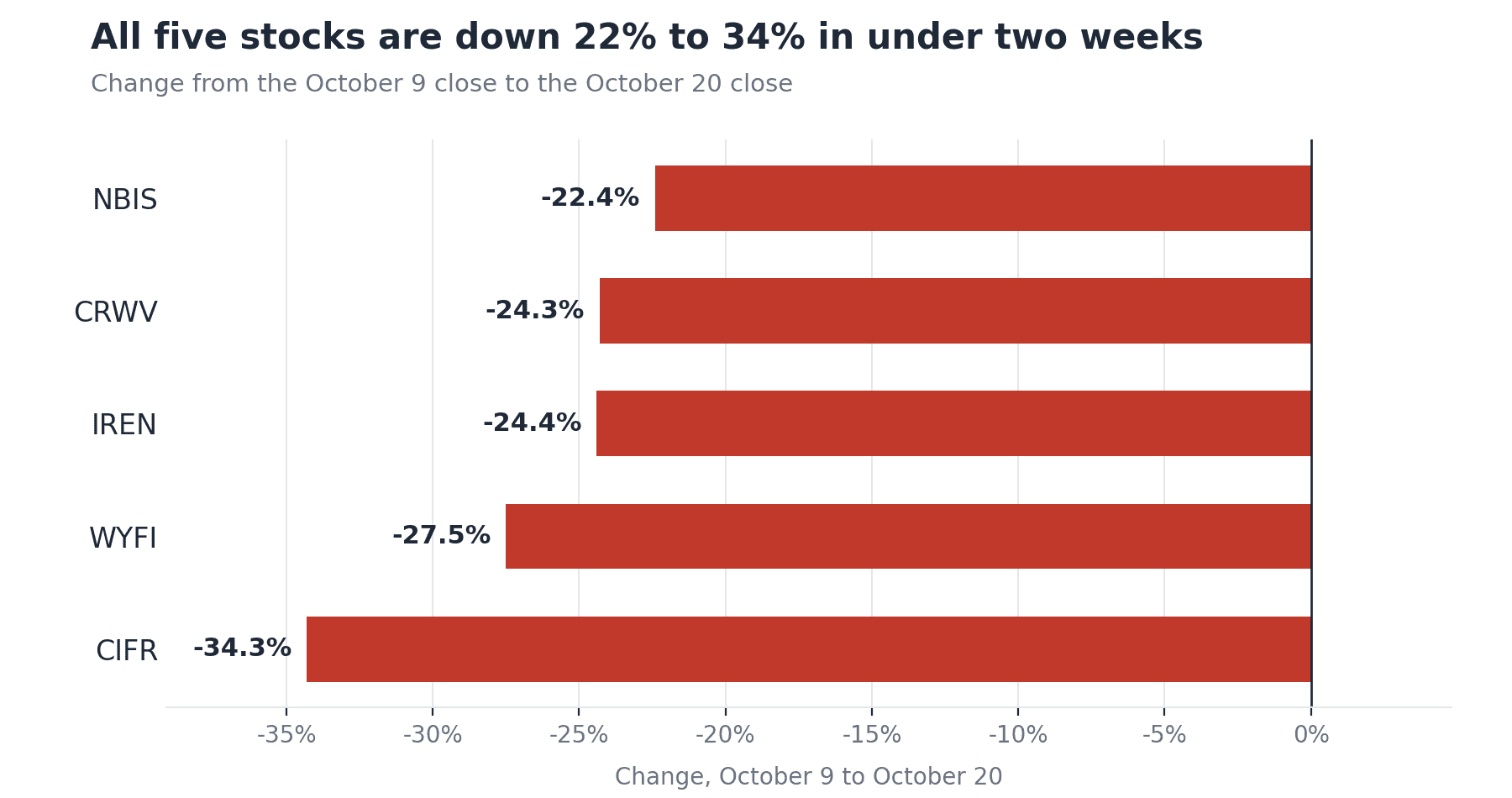
The declines reflect mounting concerns about AI infrastructure valuations, financing costs, and the returns expected from heavy capital spending. CoreWeave's bond-market stress preceded Elice's IPO, while the weak debut added another warning sign for investors reassessing the sector.
ETFs with exposure to CoreWeave
CoreWeave's stock volatility also matters to investors with indirect exposure through exchange-traded funds (ETFs). Several funds hold the AI cloud provider, including the Renaissance IPO ETF (IPO), First Trust Cloud Computing ETF (SKYY), ARK Next Generation Internet ETF (ARKW), ARK Innovation ETF (ARKK), and iShares Future AI & Tech ETF (ARTY).
Broader-market funds, including the Invesco QQQ Trust (QQQ) and Vanguard Total Stock Market ETF (VTI), also provide exposure to CoreWeave. However, the stock generally represents a smaller share of these diversified portfolios than it does in some specialised technology and AI-focused funds.
The impact of CoreWeave's share-price movements therefore varies by ETF, depending on its allocation to the stock and the performance of its other holdings. Investors should check the latest fund disclosures for current holdings and portfolio weights, as these can change over time.
What to watch next
Investors will look for disclosures on customer contracts, committed revenue, capital expenditure, and debt in upcoming company results, and for whether the postponed listings from AirTrunk and SB Energy return to the calendar. Reuters quotes Ozkardeskaya, noting that AI headlines can change quickly and that the sector's upside potential still competes with the downside risk from high valuations.