


Magnificent Seven ETFs recorded their largest monthly inflow on record in September, according to Koyfin flow data cited by Seeking Alpha. The Roundhill Magnificent Seven ETF (MAGS) took in roughly $1 billion of that flow, while gaining 4.29% over the month to close at $71.69 on September 30. The renewed demand comes as investors reassess the outlook for the Magnificent Seven after the broader AI investment story and spending on AI infrastructure dominated market attention.
Mag 7 ETF flows reach a record in September
September marked a sharp increase in demand for Magnificent Seven ETFs, with the group recording its largest monthly inflow on record. Monthly flows had been more mixed earlier in the year, with several outflow months before demand strengthened in September.
MAGS ETF Performance: How It Traded in September
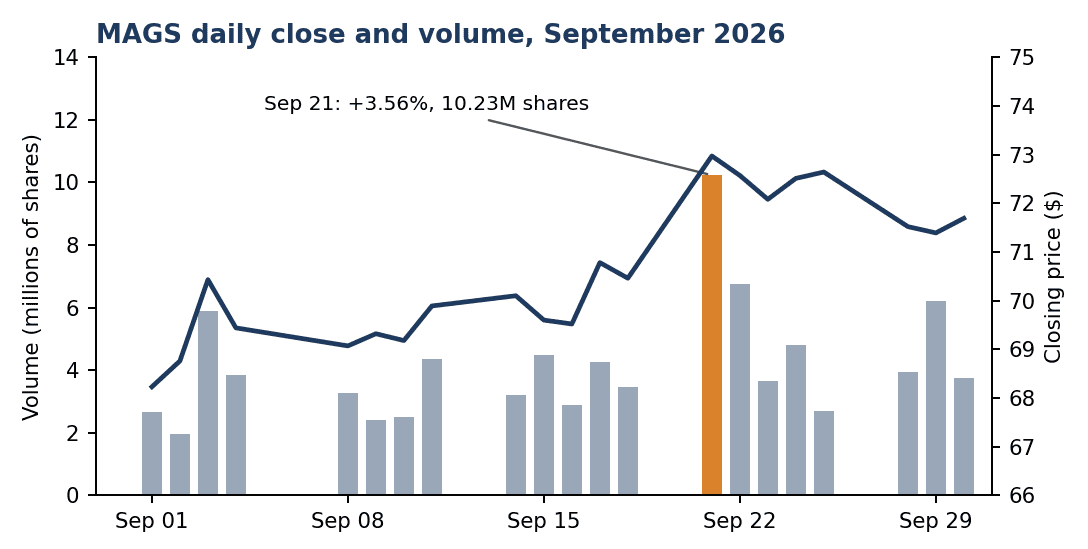
MAGS ETF gained 4.29% during September, rising from an August 31 close of $68.74 to $71.69 on September 30. The ETF traded as low as $67.37 on September 1 before reaching an intraday high of $73.46 on September 22.
Trading activity picked up sharply during the month. On September 21, MAGS posted its largest daily gain, rising 3.56% to close at $72.97, while volume surged to 10.23 million shares. Average daily volume for September was approximately 4.15 million shares. Earlier in the month, MAGS gained 2.43% on September 3 on volume of 5.89 million shares. The ETF subsequently fell 1.54% on September 28, its largest daily decline of the month.
What Stocks Does MAGS Hold?
The fund holds Apple, Microsoft, Nvidia, Amazon, Alphabet, Meta Platforms and Tesla. MAGS is designed to provide equal weight exposure and is rebalanced quarterly. Between rebalances, market movements can cause the weights to drift.
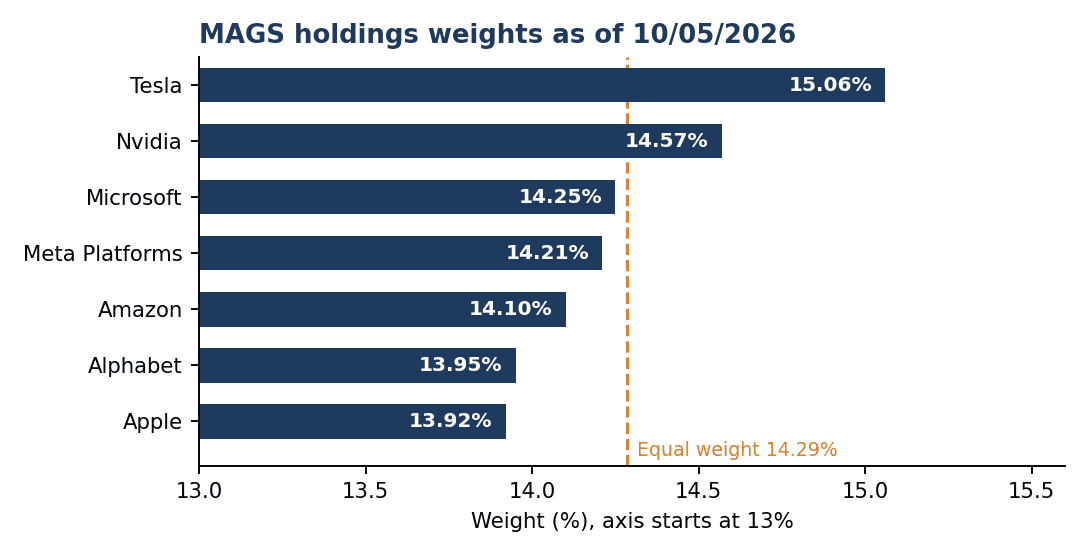
At each rebalance, each of the seven stocks is targeted at roughly 14.3%. Between rebalances, their weights can move above or below that level as share prices change. The fund combines direct stock positions with total return swaps, which Roundhill says it uses to maintain compliance with RIC diversification tests.
MAGS ETF Returns: 1-Year, 3-Year and Since-Inception Performance
How does the Mag 7 matter for GCC-listed ETFs?
The renewed interest in the Magnificent Seven also matters for GCC-listed U.S. equity ETFs. Lunate's USGRWTH has more than 60% of its portfolio allocated to the Mag 7, giving the group a significant influence on the ETF's performance. As of October 5, the seven companies accounted for approximately 64.8% of the fund's holdings.
USGRWTH top holdings
Nukoud's comparison of USGRWTH and SPUS highlights the higher Mag 7 allocation as a key differentiator between the two ETFs.
Read more: Lunate USGRWTH ETF vs. SP Fund SPUS ETF: The Key Differentiator is MAG7
What is driving the renewed demand?
The September flow data points to stronger demand for Magnificent Seven exposure. The combination of record ETF inflows and a positive monthly return raises the question of whether the group could see further upside, particularly as investor attention remains focused on AI spending and earnings growth.
The broader market backdrop was also supportive. U.S. equity funds recorded $20.6 billion of net inflows in the week ending September 30, while U.S. large-cap equity funds attracted $19.33 billion, according to LSEG Lipper data. The Nasdaq Composite also reached record highs during the period, supported by continued demand for AI-related stocks.
For MAGS, however, the next test is whether September's exceptional flow can continue. Sustained inflows in the coming months would provide a stronger indication that demand for Magnificent Seven exposure is holding up, rather than September's record flow being a short-term response to recent performance.