


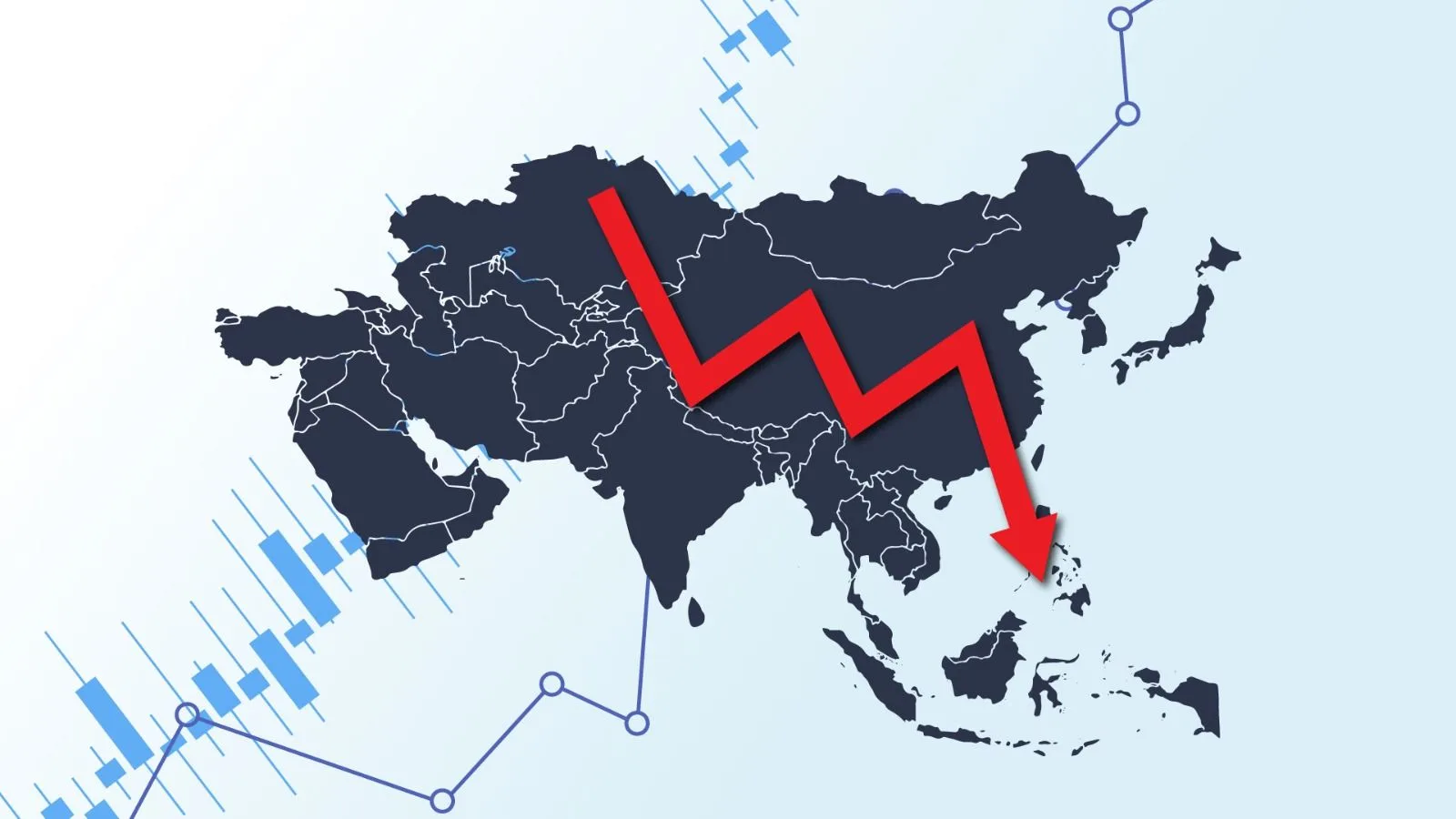
South Korea's Kospi recorded the steepest decline among the markets listed, while Japan's semiconductor equipment and memory-chip stocks also suffered heavy losses. SK hynix dropped 10.1%, and Samsung Electronics lost 7.4%, while Japan’s Nikkei 225 fell 1.8%. The sell-off reflected growing concerns over AI valuations, rising competition from China’s CXMT and whether the enormous investment in AI infrastructure will deliver sustainable returns.
Asian Stock Market Today: Key Index Closing Levels
The Kospi closed down 5.5% at 6,035.35 after falling more than 7% at its intraday low. SK hynix ended down 10.1%, and Samsung Electronics fell 7.4%, according to AP. The Nikkei 225 closed down 1.8% at 67,777.52, with Kioxia down more than 13%, Advantest down more than 8% and Tokyo Electron down more than 7%. TSMC fell about 2%, while Taiwan's Taiex closed down 1.95% at 48,341.31, according to Focus Taiwan (CNA).
Asian Stock Market Performance on 13 October 2026
Not every market fell. Singapore and Mumbai edged higher, and London, Paris and Frankfurt advanced. Around 0810 GMT, the FTSE 100 was up 0.8% at 10,742.72, which is an intraday reading and not a close. The Dow Jones closed Monday up 0.4% at 51,850.55. The damage concentrated in markets with the heaviest exposure to semiconductors.
Why Semiconductor Stocks Led the Asian Market Sell-Off
Three concerns converged to pressure Asian technology stocks: weakness in US semiconductor shares, growing competition from China, and doubts about the returns on AI investment.
1. US Semiconductor Stocks Extend the AI Sell-Off
The sell-off followed a decline in US semiconductor shares. Micron Technology fell 3.9%, while SanDisk lost almost 6%. The weakness spread to Asian manufacturers, where memory-chip producers and semiconductor equipment suppliers are closely tied to global AI infrastructure spending. These concerns reflect wider questions about AI companies’ revenue expectations and investment plans, as explored in our analysis of how OpenAI’s revenue expectations sent AI stocks and ETFs lower.
2. China’s CXMT Intensifies Competition in Memory Chips
Chinese memory-chip maker ChangXin Memory Technologies (CXMT) reported progress on a 4F² memory-cell architecture designed to increase memory density. According to the South China Morning Post, CXMT President Cao Kanyu said the company plans to introduce a server-memory product based on the design by the end of 2026.
The development could increase competition for Samsung Electronics and SK hynix, which are also pursuing similar technologies. However, the announcement does not establish that CXMT can manufacture the design at scale or match established producers on yields, performance, and profitability. Pepperstone's Chris Weston said China's ability to develop competitive products at lower cost was challenging assumptions about market share, pricing power and margins.
3. AI Valuations Under Pressure as Investors Question Returns
Broadcom CEO Hock Tan added to valuation concerns at an event in Singapore on 12 October, comparing speculative AI investment behaviour to gambling. He questioned whether investors' expectations were realistic and highlighted the funding required to expand AI infrastructure. His comments pointed to uncertainty over returns rather than a forecast that AI demand would collapse.
OpenAI's financial figures illustrate the distinction between revenue growth and profitability. Reuters reported on 8 October that its September annualised revenue was nearly $50 billion, compared with an earlier reported run-rate estimate approaching $70 billion. The figures are not directly comparable without accounting for differences in revenue definitions and cloud-partner arrangements. Annualised revenue is a run-rate measure, not actual full-year revenue, and does not establish profitability.
Investors are reassessing not only the growth potential of AI, but also which companies can defend their margins, finance expansion and convert rising demand into sustainable earnings.
Why Asian Markets Are Vulnerable to AI Stock Volatility
AI-related hardware is now an important driver of Asian equity performance, particularly in Taiwan and South Korea and in parts of China's technology sector. This concentration means that shifts in semiconductor earnings expectations, competition and AI spending have an outsized effect on regional indices. Investors need to separate the long-term outlook for AI demand from the near-term performance of individual companies.
Middle East Tensions and the Oil Price Outlook
Geopolitical tension added to the uncertainty after further incidents were reported at Riyadh's King Khalid International Airport. Reuters reported on 12 October that Saturday's attack on Riyadh airport killed 13 people and injured more than 300, while a subsequent attack on Sunday killed one person and injured 11. A Houthi official also warned the United States of a "painful response" if it entered the conflict in Yemen.
Oil prices declined during Tuesday's session, although Brent crude remained above $100 per barrel. Energy-importing economies such as South Korea and Japan remain exposed to elevated costs.
What it means for GCC investors
For GCC investors, the Asian sell-off highlights the potential impact of global technology-sector volatility on internationally diversified portfolios. Regional implications should be assessed alongside local equity performance, oil prices and developments in the Middle East. Without verified GCC closing data for 13 October, the effect on Gulf markets remains uncertain.
Higher oil prices can support government revenues across oil-exporting economies, but escalating regional tensions may also increase security risks, disrupt shipping routes and weigh on investor confidence. These competing forces are particularly relevant to Saudi Arabia, where the economic outlook depends partly on oil-market conditions and regional stability. Read our analysis of how the escalating Yemen conflict could put Saudi Arabia’s 12.8% GDP growth forecast for 2027 at risk.
Investors with global equity or Asia-focused ETF holdings also face exposure to semiconductor stocks affected by concerns over AI valuations and intensifying competition from Chinese chipmakers. The implications for GCC portfolios will depend on their regional allocations, sector exposure, and sensitivity to changes in oil prices.
Semiconductor and Technology ETFs to Watch
Investors tracking the AI sell-off can explore ETFs offering exposure to semiconductor manufacturers, chip designers and the broader AI ecosystem.
- Global semiconductor ETFs: VanEck Semiconductor ETF (SMH), iShares Semiconductor ETF (SOXX), Invesco PHLX Semiconductor ETF (SOXQ), SPDR S&P Semiconductor ETF (XSD), First Trust Nasdaq Semiconductor ETF (FTXL) and Global X AI Semiconductor & Quantum ETF (CHPX).
- GCC-listed technology and AI ETFs: Albilad MSCI US Tech ETF (9407), listed on Tadawul, provides exposure to US technology companies. KraneShares Public-Private AI & Technology ETF (AGIX), cross-listed on ADX, offers broader AI and technology exposure, including semiconductor-related companies.
These funds differ in geographic exposure, holdings and sector concentration. The GCC-listed funds are not dedicated semiconductor ETFs. Investors should verify current listings, holdings, fees, and liquidity before investing.
What to watch next
Traders are watching earnings from leading technology firms this month and next for signals on AI demand and capital spending. CXMT's product timeline, US data releases, bond yields, and any escalation in Yemen remain the key variables.