JPMorgan has upgraded the MSCI UAE Equity Index from neutral to overweight, pointing to the country's economic resilience, improving corporate earnings expectations and renewed foreign investor interest despite months of regional conflict. The decision, announced on November 17, 2026, reflects a more optimistic outlook for UAE equities heading into 2027, even as geopolitical uncertainty continues to weigh on financial markets across the Gulf.
According to JPMorgan, earnings forecasts for UAE-listed companies have turned positive, valuations offer room for further gains and foreign capital has begun returning to the market. The bank expects UAE equities to outperform the broader Central and Eastern Europe, Middle East and Africa (CEEMEA) region.
The upgrade follows a challenging period for regional markets. The conflict involving the United States and Iran, which began in February, disrupted energy shipments through the Strait of Hormuz and raised concerns about the Gulf's economic outlook. During the first half of 2026, the UAE's gross domestic product reached AED 961.9 billion, representing annual growth of 0.4%, according to figures reported by The National. Non-oil industries accounted for 79.2% of economic output, reflecting the growing importance of activity outside the energy sector.
The shift in sentiment also places renewed attention on UAE equity exchange-traded funds (ETFs), which provide diversified exposure to companies listed on the Abu Dhabi Securities Exchange (ADX) and Dubai Financial Market (DFM).
One instrument is the US-listed iShares MSCI UAE ETF (UAE), which tracks an index of large- and mid-cap UAE equities. Investors seeking locally listed alternatives can explore Nukoud's UAE ETF directory, including funds offering Shariah-compliant exposure.
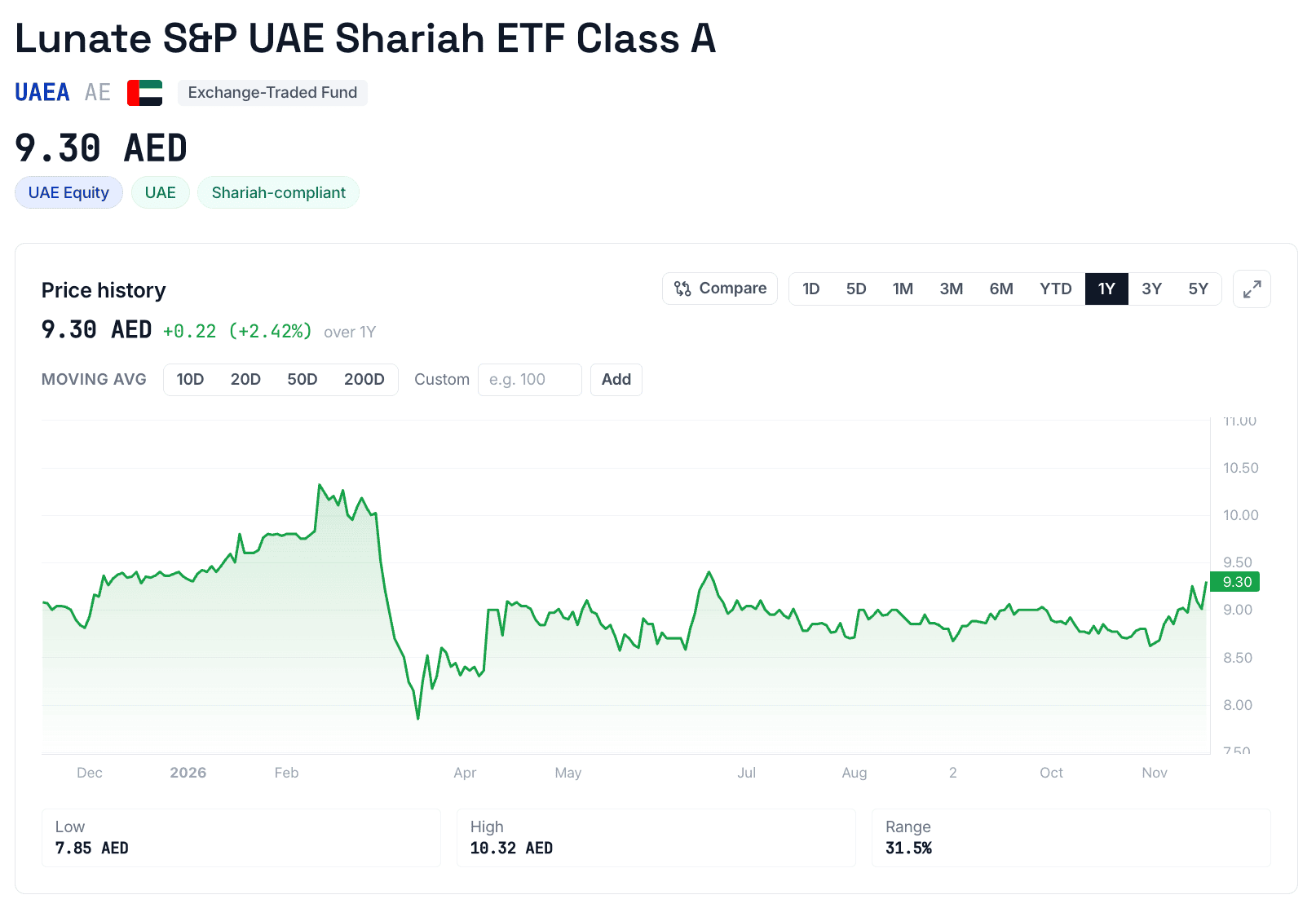
The renewed optimism is already reflected in ETF performance. The UAEA ETF is trading at AED 9.30, its highest level since the regional conflict began in late February. The fund has recovered from its March low of AED 7.85, reflecting a rebound in UAE equities as investor sentiment improves. The recovery provides an early indication that confidence is returning to the market, although the sustainability of the rally will depend on corporate earnings and regional stability.
Recent corporate developments could also influence fund performance. As Nukoud reported, planned capital increases at First Abu Dhabi Bank and Abu Dhabi Islamic Bank have implications for several UAE-focused ETFs. Meanwhile, Emaar Properties' proposed $3.4 billion buyout of Emaar Development could eventually affect index composition and portfolio allocations.
JPMorgan's upgrade offers an encouraging signal, although risks remain. Continued disruption to regional shipping, renewed geopolitical escalation and weaker-than-expected corporate earnings could challenge the recovery.
Investors evaluating UAE exposure can compare available ETFs on Nukoud, taking account of portfolio concentration, fees, liquidity and fund domicile. With foreign inflows returning and earnings expectations improving, the next test for UAE equities will be whether corporate results can sustain the renewed confidence through 2027.