
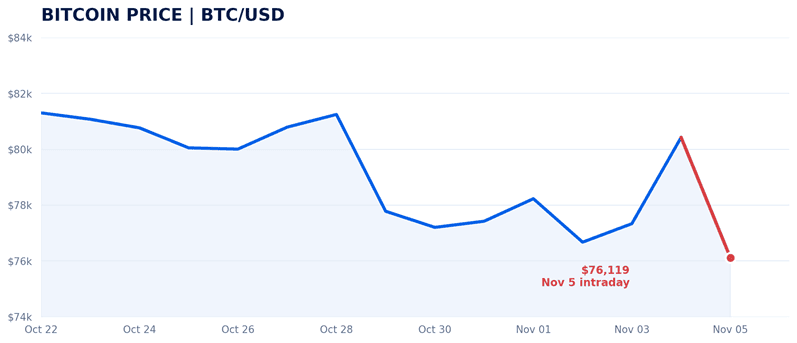
Chart: BTC/USD daily closing marks, Oct 22–Nov 4, 2026; Nov 5 is an intraday quote at approximately 12:03 p.m. EST, not a daily close. Source: ChartExchange.
Bitcoin fell toward $76,000 on November 5 after a brief recovery above $80,000 reversed as US technology shares sold off. The decline accelerated as roughly $370 million in leveraged cryptocurrency positions were liquidated within about an hour, according to market reports. The episode underscores how closely crypto markets can move with wider risk sentiment during periods of stress.
Why Bitcoin is under pressure
Technology market weakness. The Bitcoin reversal coincided with a sharp decline in US technology stocks, particularly AI-related names. Worries over valuations and potential restrictions on data-center development added to a broader shift away from riskier assets.
Forced selling from leverage. When Bitcoin dropped below $77,000, automatic closures of leveraged bullish bets accelerated the move. Such derivatives liquidations are different from investors redeeming shares in spot Bitcoin ETFs.
Volatility across digital assets. Ether, Solana and other cryptocurrencies declined alongside Bitcoin, illustrating the market-wide nature of the selloff.
BlackRock’s IBIT: outflows, but a mixed ETF market
US-listed spot Bitcoin ETFs have become a major route for investors to gain Bitcoin exposure through brokerage accounts. IBIT, BlackRock’s iShares Bitcoin Trust ETF, recorded net outflows of $405.3 million on November 2, $95.0 million on November 3 and $201.2 million on November 4—approximately $701.5 million over three sessions.
Nevertheless, the combined US spot Bitcoin ETF market registered $74.6 million in net inflows on November 4, supported by approximately $236.7 million into Fidelity’s FBTC. Across November 2–4, the group experienced about $439.6 million of net outflows. These figures show uneven investor positioning rather than a uniform exit from all funds.
Where Grayscale’s Bitcoin ETFs fit
Grayscale offers two US-listed spot Bitcoin products: the long-established Grayscale Bitcoin Trust ETF (GBTC), converted to an ETF in January 2024, and the lower-fee Grayscale Bitcoin Mini Trust ETF (BTC), which began trading in July 2024. Both seek exposure to the underlying Bitcoin price, but have different fee structures.
| Ticker | Fund | Annual fee |
IBIT | iShares Bitcoin Trust ETF (BlackRock) | 0.25% |
GBTC | Grayscale Bitcoin Trust ETF | 1.50% |
BTC | Grayscale Bitcoin Mini Trust ETF | 0.15% |
Fund fees as reported in issuer and ETF-data disclosures; subject to change.
Grayscale’s BTC fund saw approximately $52.6 million in net outflows on November 3. Neither GBTC nor BTC recorded net creations or redemptions on November 4, based on the latest finalized daily figures.
What the selloff means for ETF holders
Spot Bitcoin ETFs simplify access to Bitcoin through listed securities, but they do not insulate investors from the cryptocurrency’s sharp price swings. ETF market prices can also deviate temporarily from the underlying value because of trading spreads and premiums or discounts. Fund flows provide a useful window into demand but are not a reliable standalone indicator of the next price move.
The $75,000 area is attracting market attention, but no price level guarantees support. The more important question for ETF investors is whether macroeconomic and technology-sector volatility continues to shape Bitcoin sentiment.
NUKOUD TAKEAWAY The spot ETF structure has broadened access to Bitcoin, not reduced its volatility. IBIT’s three-day redemptions were substantial, yet competing funds still attracted fresh capital—evidence of a market repricing risk rather than a single, uniform investor response.
Sources and data notes
• Bitcoin market selloff and liquidations — The Economic Times, Nov 5, 2026
https://economictimes.indiatimes.com/news/international/us/why-is-bitcoin-price-crashing-today-btc-usd-falls-toward-76000-amid-stock-market-sell-off-and-370-million-in-crypto-liquidations/articleshow/135579593.cms?from=mdr
• BTC/USD daily closing and intraday chart marks — ChartExchange, accessed Nov 5, 2026
https://chartexchange.com/symbol/crypto-btcusd/historical/
• Spot Bitcoin ETF net flows, Nov 2–4 — Bitcoin ETF Flow Tracker (Farside-based), accessed Nov 5, 2026
https://bitcoinalmanack.com/etfs/bitcoin-etf-flow-tracker/
• Spot Bitcoin ETF fund fee comparison — ETF market-data comparison, accessed Nov 5, 2026
https://cmc.io/charts/etf/bitcoin
Disclosure: This article is intended solely for general market education and information, not as financial advice or an investment recommendation. ETF and cryptocurrency prices can be highly volatile; past performance is not indicative of future returns. Price data for November 5 are intraday and may change.