


The UAE's announcement that it will formally leave OPEC and OPEC+ on May 1, 2026 has been framed in the financial press as a geopolitical rupture. A blow to OPEC, a win for anti-cartel rhetoric, a casualty of the Hormuz crisis.
All of that may be directionally true. But for anyone with a P&L attached to crude, the more relevant takeaway is simpler: a large pool of flexible production capacity is no longer bound by a quota system, and the benchmark most directly tied to that capacity trades out of Fujairah.
For the past five years, Murban has been a benchmark searching for a clearer role alongside Dubai and Brent. The UAE’s exit may provide that.
Why the UAE actually left
Strip away the diplomatic language and three dynamics appear to be converging.
First, the UAE has been quota-frustrated for years. Abu Dhabi has invested heavily to lift capacity toward about 4.85 million b/d, while other producers have periodically exceeded quotas without clear enforcement. The UAE’s stated ambition to reach about 5 million b/d by 2027 sits somewhat uneasily within a coordinated supply framework.
Second, the Hormuz situation has reframed logistics risk. With periodic disruption to Gulf shipping, export optionality matters more. The Habshan–Fujairah pipeline, which bypasses the Strait of Hormuz and connects directly to the Murban delivery point, becomes strategically central. The exit can be read, in part, as a consolidation around infrastructure the UAE fully controls.
Third, and more structurally, the UAE’s hydrocarbon strategy has evolved. ADNOC remains a major upstream producer, but it has also expanded aggressively into gas, LNG, chemicals, trading, and downstream integration. That diversification may reduce the relative importance of strict quota adherence compared to more oil-dependent peers.
What the exit actually does to the cartel
OPEC does not immediately lose physical barrels, but it does lose a significant portion of its non-Saudi flexibility. Saudi Arabia likely retains the central price-management role, but the broader system becomes more asymmetric.
The key issue is not whether the UAE increases production immediately. It likely cannot do so materially in the near term given logistical constraints. The issue is how future coordination is perceived. The next time OPEC seeks to defend a price floor through coordinated cuts, one of the larger and more credible participants in that framework is no longer inside it.
Markets tend to price that kind of structural asymmetry ahead of observable data.
The first-order effect on flat price may remain muted in the near term. The second-order effects on curve structure and inter-benchmark spreads are more likely to be where tradable dislocations emerge.
Murban: the contract finally gets its moment
A quick refresher. Murban is ADNOC’s flagship light sweet grade, around 39.9° API and 0.78 percent sulfur, produced at scale from onshore Abu Dhabi. The futures contract, launched on ICE Futures Abu Dhabi in March 2021, is physically delivered FOB Fujairah and clears alongside Brent and WTI.
Liquidity has grown meaningfully. By 2024, volumes had reached levels that put Murban firmly beyond regional contract status, even if it is not yet Brent-deep.
The UAE’s exit does not automatically make Murban a global benchmark. It does remove one of the structural arguments against it. Three shifts are worth highlighting.
OSP linkage becomes less constrained.
Within OPEC+, the relationship between Murban futures pricing and ADNOC’s official selling prices (OSP) existed alongside quota constraints that influenced available supply. Outside that framework, the futures curve may more directly reflect unconstrained marginal supply. That alignment is generally a feature of benchmark-grade pricing, even if not sufficient on its own.
The Dubai basket relationship may evolve.
Recent changes in Platts methodology already suggest a more flexible relationship between Murban and other Middle East grades. If Murban volumes increase and pricing becomes more responsive to market conditions, it may play a more active role in setting relative value within the Dubai-linked complex. Whether it consistently acts as a floor rather than a premium is still an empirical question, but the direction of travel points toward greater influence.
Asian arbitrage dynamics may shift.
Murban’s pricing relationship with WTI has narrowed as liquidity has improved. If export volumes increase and pricing becomes more transparent, Murban may become a more competitive reference for light sweet crude flows into Asia. The extent to which this displaces U.S. barrels will depend on freight, refinery configurations, and relative pricing, so this should be viewed as a developing dynamic rather than a certainty.
A note on transparency
On April 28, the same day as the OPEC exit announcement, ADNOC Onshore indicated that it would suspend publication of its Murban Export Availability Report:
In light of the current situation in the Gulf, ADNOC Onshore has taken the decision to suspend the monthly Murban Export Availability Report. ADNOC Onshore continues to make available Murban crude volumes for export.
This report has been a useful input for estimating spot availability and modeling differentials. Its suspension does not necessarily change physical volumes, but it does reduce visibility into how those volumes are distributed.
The implication is not that supply disappears, but that market participants must infer it indirectly through loading programs, AIS data, and nominations. In many commodity markets, reduced transparency in physical flows tends to increase volatility in prompt differentials and shift activity toward futures markets.
If that pattern holds, it could support further development of IFAD liquidity even as it complicates physical trading.
How to think about the trade
This is where it makes sense to separate structural views from tactical expressions.
A structural view is that Murban’s role in the global pricing system may increase relative to Dubai. One way to express that is through Murban versus Dubai spreads, with the expectation that relative pricing relationships adjust over time. This is likely a gradual process rather than a discrete move.
A shorter-horizon opportunity may exist in Brent-Murban volatility. One force pushes toward relative Murban weakness as supply flexibility increases. Another pushes toward strength during periods of Gulf disruption. The interaction of those forces may create realized volatility that exceeds what is currently implied.
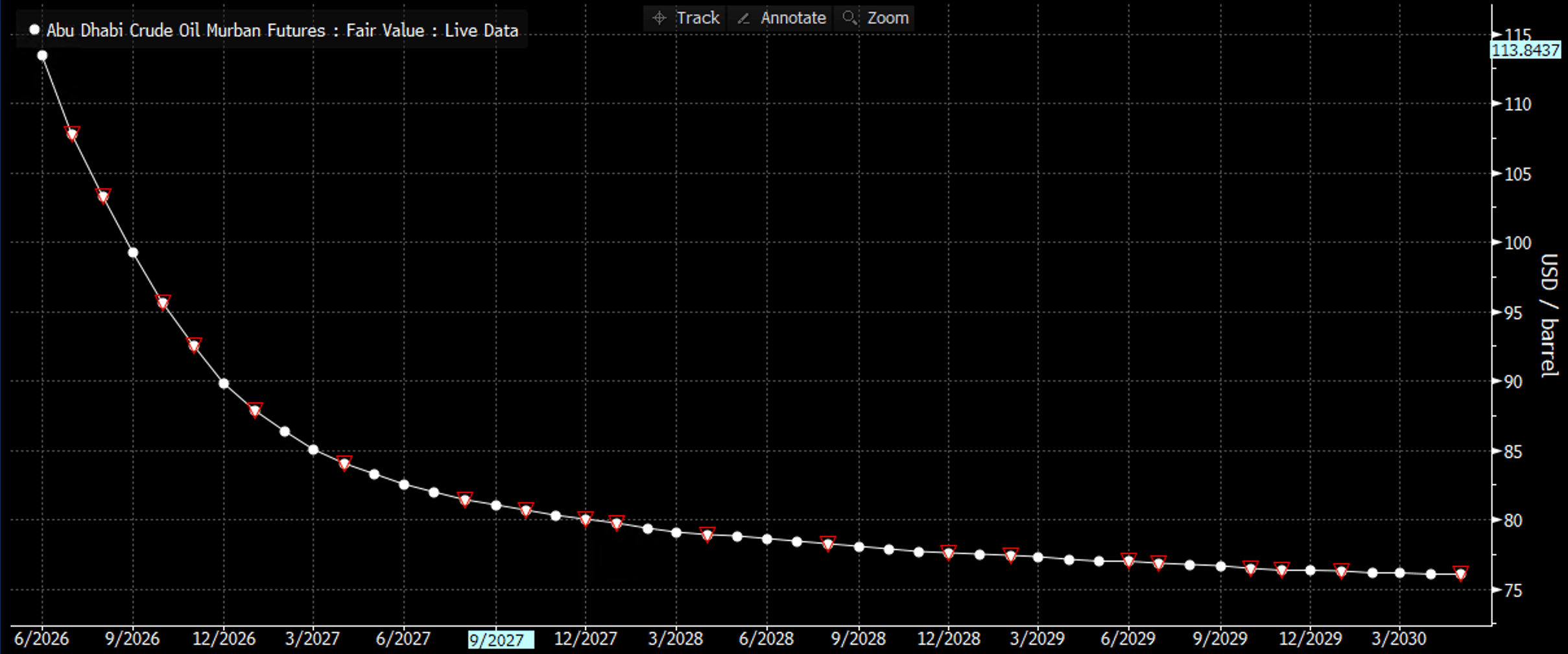
The curve trade requires more precision than labels. Murban has exhibited strong backwardation during periods of logistical stress. If those stresses ease, the prompt premium may compress. A clean way to express that view is to sell strength in prompt spreads relative to deferred months. The spread compression is the core thesis.
Finally, ADNOC’s pricing of other grades relative to Murban may become more dynamic outside a quota framework. For participants with physical exposure, relative value across ADNOC-linked grades could become a more active area.
What not to do
It is less compelling to treat the UAE’s exit itself as a directional flat-price trade in Murban. The event is known, the near-term supply picture is constrained by logistics, and broader macro drivers are likely to dominate outright price moves.
The more interesting opportunities sit in relationships rather than levels.
Two risks worth highlighting
One risk is behavioral. If Saudi Arabia responds by prioritizing market share over price stability, the broader crude complex could reprice lower. In that scenario, Murban may not outperform despite structural arguments in its favor.
Another risk is liquidity. IFAD has developed quickly, but it is not yet as deep as Brent. In stressed conditions, execution quality may deteriorate, especially for larger spread positions.
The bigger picture
For a decade, the question around Murban has been whether it could evolve into a widely used benchmark or remain primarily a pricing tool for ADNOC’s own flows.
The UAE’s exit from OPEC does not settle that question completely, but it shifts the balance. A benchmark requires a sizable and flexible physical base, credible price discovery, and sustained participation. Murban arguably strengthens on the first and third of those, while the transparency question becomes more nuanced in the near term.
The broader takeaway is that Middle East crude pricing is becoming more distributed. Fujairah, through Murban, is increasingly part of that structure rather than a peripheral node.