
NukoudYour Home for ETF News in the GCC
Sign in
ETF Trends
ETF Education
Investing & Themes
Markets & Data
ReportsVideos
ETF Screener
Nukoud
ETF Trends
ETF Education
Investing & Themes
Markets & Data
ReportsVideos
ETF Screener
Sign in

Advertisement

KraneShares Abu Dhabi - Leaderboard

Footer

Stay informed

GCC ETF news & analysis, direct to your inbox.

Free. Unsubscribe anytime.

Nukoud

Your home for ETF news in the GCC. Independent coverage of exchange-traded funds, investing themes, and market trends across the Gulf Cooperation Council.

Nukoud does not provide investment advice.

Sections

  • ETF Trends
  • ETF Education
  • Investing & Themes
  • Markets & Data
  • GCC
  • Reports

Tools

  • ETF Themes
  • ETF Screener
  • ETF Compare
  • Portfolio Builder
  • Lite Mode

Company

  • About
  • Contact
  • Careers

Legal

  • Privacy Policy
  • Terms of Service
  • Cookie Policy
  • Disclosures
  • Editorial Standards

All content on Nukoud is provided for informational purposes only and does not constitute investment advice, a recommendation, or an offer to buy or sell any security. Past performance is not indicative of future results. Readers should conduct their own research and consult qualified financial professionals before making investment decisions.

© 2026 Nukoud LLC. A Sharjah, UAE registered company. All rights reserved.v1.0.0 · 54aa6ae

  1. Home
  2. ETF Trends
  3. GCC bond and sukuk issuances hit $55 billion in Q1 2026
ETF Trends

GCC bond and sukuk issuances hit $55 billion in Q1 2026

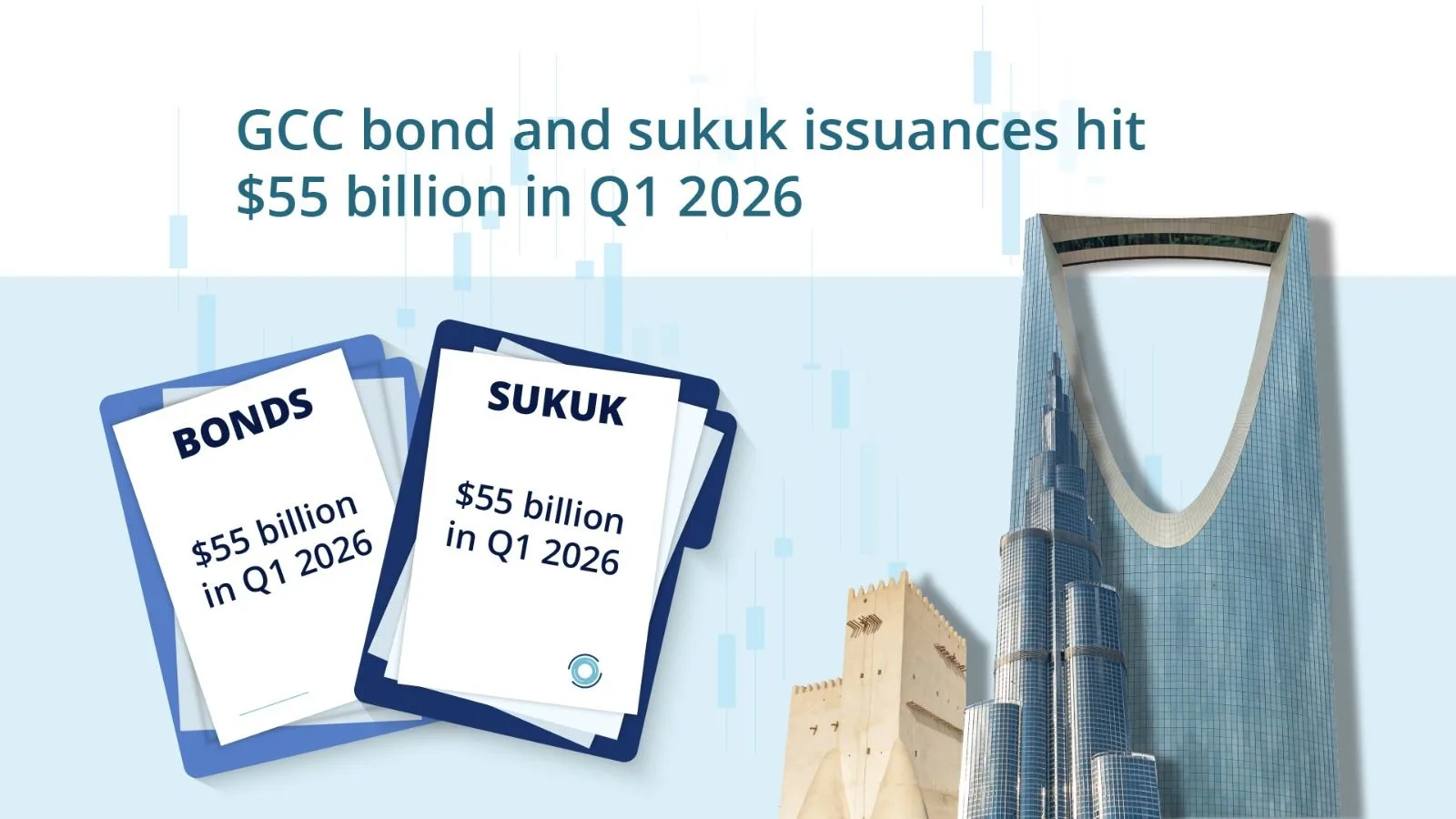
GCC bond and sukuk issuances reached $55.04 billion in Q1 2026, up 5.64% year-on-year across 95 deals. Saudi Arabia dominated with $32.54 billion while the UAE posted sharp 33.1% growth.

April 29, 20263 min read
GCC bond and sukuk issuances hit $55 billion in Q1 2026

Q1 2026 saw GCC primary bond and sukuk issuances rise 5.64% year on year to $55.04 billion across 95 deals, driven by Saudi sovereign borrowing and a resurgent UAE. Yield spreads widened sharply late in the quarter as the Iran conflict prompted issuers to pause transactions.


After a 6.1% contraction in Q1 2025, GCC primary issuances rebounded to $55.04 billion,  nearly matching the Q1 2024 peak of $55.5 billion. The recovery was broad-based, with five of six GCC members posting volume gains. Total outstanding GCC debt capital market securities now stand at $1.2 trillion, up 14% year on year.

Geographic Breakdown

Saudi Arabia dominated with $32.54 billion across 42 deals (59.1% market share), up 3.1% year on year. The UAE delivered the quarter's sharpest growth, up 33.1% to $13.57 billion across 36 deals,  reflecting its maturing corporate debt market and strong Nasdaq Dubai activity. Qatar was the sole underperformer, falling 41.2% to $4.20 billion due to timing.. Bahrain (+37.2%) and Kuwait (+40.7%) posted strong gains from lower bases.

Sector, Instrument & Deal Size

Government entities led by value ,  12 issuances raised $20.46 billion (37.2%), up 5.5% year on year. Financials dominated by count (64 of 95 deals) but fell 14% in aggregate value to $19.45 billion, as issuers shifted to smaller, shorter-dated paper. Energy contributed $5.52 billion across 6 deals, largely project-level sukuk from Saudi Arabia and the UAE.


Just 20 deals above $1 billion generated $33.33 billion,  60.6% of total volume, showing GCC sovereigns' preference for large benchmark transactions. USD dominated currency composition at 85% of volume or $46.78 billion across 62 transactions, reflecting the dollar-peg arrangements of most GCC members. Saudi Riyal issuances ranked second at $4.04 billion; 10 SGD-denominated deals worth $897 million signal deepening ties with Asian institutional investors.


Conventional bonds grew faster than sukuk (+6.2% vs +4.6%), driven by the UAE's preference for USD conventional paper. Globally, sukuk outstanding crossed $1.1 trillion at the end of Q1 2026, up 15% year on year. Saudi Arabia accounted for 61% of ESG sukuk activity in Q1, making Islamic instruments the dominant vehicle for sustainability-linked financing in the region.

Geopolitical Headwinds

The outbreak of the Iran conflict in late February 2026 introduced significant market volatility. New issuances fell sharply, with many deals placed on hold. By March 10, the S&P MENA Sukuk Index yield had risen 32 basis points to 4.78%; the conventional bond index widened 28bp to 5.01%. High-yield sukuk spreads moved more sharply, rising 79bp to 6.61%.


The GCC accounts for approximately 40% of all emerging market dollar issuance in 2026, excluding China. A sustained pause in Gulf issuances carries significant implications for EM debt markets globally. 


Fitch Ratings

"GCC issuances were strong at the start of 2026, with many entities aiming to benefit from favourable conditions ahead of the typical Ramadan slowdown."

Outlook

The structural pipeline remains strong with $174.5 billion in fixed-income Saudi Arabia bonds projected to mature between 2026 and 2030, closely followed by the UAE at $171.8 billion. Refinancing alone is expected to generate approximately $85.4 billion in new issuances across 2026. Full-year volumes may exceed last year's record as geopolitical conditions stabilise.
Fixed IncomeGCC

Get the Nukoud newsletter

ETF news and analysis for the GCC, delivered to your inbox. Free, no spam, unsubscribe anytime.

Related Articles

Nasdaq rewrites its rulebook for share-class of mutual funds and the potential next wave of ETFs is coming
ETF Trends

Nasdaq rewrites its rulebook for share-class of mutual funds and the potential next wave of ETFs is coming

Nasdaq's regulatory filing enables mutual funds to issue ETF shares off the same portfolio, potentially unlocking $20 trillion in US mutual fund assets for exchange trading. This structural innovation offers tax efficiency benefits and expanded US equity access for GCC investors.

April 28, 2026
UAE Exit from OPEC+, Shift in Oil Policy
News

UAE Exit from OPEC+, Shift in Oil Policy

The UAE has announced its exit from OPEC and OPEC+ effective May 1, 2026, signaling a strategic shift toward independent oil production management while maintaining market stability.

April 28, 2026
Hedge Funds Are Using ETFs More Than Ever
Markets & Data

Hedge Funds Are Using ETFs More Than Ever

Hedge funds have tripled their ETF exposure to approximately $300 billion over the past three years, using ETFs as trading tools, hedges, and liquidity instruments rather than traditional buy-and-hold investments.

April 27, 2026
US-UAE Currency Swap Line: What It Is, Why It Matters, and Why Markets Care
Markets & Data

US-UAE Currency Swap Line: What It Is, Why It Matters, and Why Markets Care

The US and UAE are discussing a potential currency swap line to provide dollar liquidity access during regional financial stress. This crisis insurance mechanism reflects evolving trade and security dynamics rather than economic weakness.

April 27, 2026

Fund Lookup

Popular ETFs

KWEB

—
EGX30ETF

—
ALBIGOLD

—
BILADETF

—
View All ETFs

Tools

ETF Screener

Filter & compare ETFs

ETF Compare

Side-by-side comparison

Portfolio Builder

Coming soon

Popular ETFs

KWEB

—
EGX30ETF

—
ALBIGOLD

—
BILADETF

—
View All ETFs

Tools

ETF Screener

Filter & compare ETFs

ETF Compare

Side-by-side comparison

Portfolio Builder

Coming soon

Advertisement

KraneShares Abu Dhabi - Leaderboard

Advertisement

KraneShares Abu Dhabi - Rectangle

Webinars

Invest in Private and Public AI Companies with AGIX, the KraneShares Artificial Intelligence and Technology Fund

Invest in Private and Public AI Companies with AGIX, the KraneShares Artificial Intelligence and Technology Fund

Replay on Demand
KWIN ETF: A New Way to Earn Shariah-Compliant Income — Webinar

KWIN ETF: A New Way to Earn Shariah-Compliant Income — Webinar

Replay on Demand
All webinars →