The 10-year US Treasury yield breached 5% on Monday and climbed above 5.02% on Tuesday, its highest level since 2007, as surging oil prices and a hotter-than-expected core inflation reading strengthened expectations for a Federal Reserve rate hike at this week's policy meeting. The move deepened a global bond sell-off, supported the dollar, and hit risk assets, with semiconductor stocks bearing the brunt of a separate wave of AI-slowdown concerns.
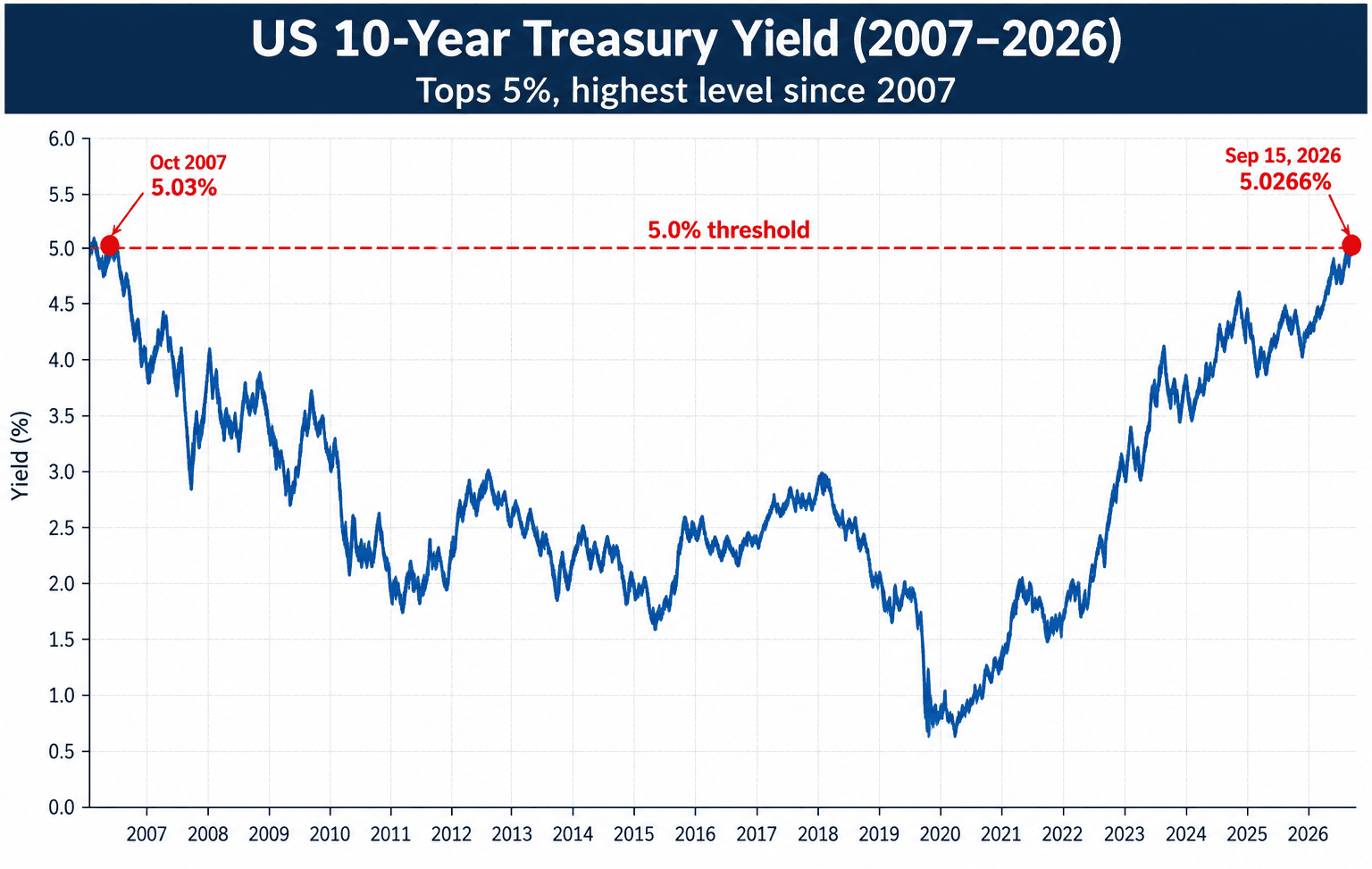
Why Is the US 10-Year Treasury Yield Rising?
Oil has been the immediate trigger. Brent crude touched above $109 a barrel earlier in the week before easing to around $107, while US crude traded near $103.24, after Yemen's Houthi movement launched fresh attacks on Saudi Arabia and Riyadh linked an earlier strike on its east-west pipeline capable of disrupting up to 4% of global supply to Iran-backed fighters in Iraq. Gulf states postponed planned talks with Iran. Adding to the supply risk is the sharp decline in shipping through the Strait of Hormuz, which historically carries roughly a fifth of global oil and LNG supplies: only four commodity vessels transited the waterway on Monday, versus a pre-war average of 125 daily, though oil flows have held up better than vessel counts alone suggest.
Beyond oil, investors are also weighing Treasury supply and fiscal concerns, with heavy government debt issuance to fund deficits and increased corporate borrowing for AI infrastructure adding to the supply of bonds competing for investor demand.
How Inflation and Fed Rate-Hike Expectations Are Driving Yields
August headline CPI rose 0.4% month-on-month and 3.4% year-on-year, in line with forecasts. But core CPI, which excludes food and energy, rose 0.3%, above the 0.2% economists expected, reinforcing concerns that underlying inflation remains sticky.
Goldman Sachs, JPMorgan, HSBC and Deutsche Bank have all shifted to forecasting a hike this week after previously expecting the Fed to hold. HSBC economist Ryan Wang summed it up: "Lack of inflation progress has tipped the balance." Reuters-polled economists also expect at least one further hike by March 2027.
Global Bond Yields Rise as US Treasury Yields Top 5%
The move highlights pressure at the long end of the curve: while the 2-year yield is more sensitive to Fed expectations, the 10- and 30-year yields also reflect inflation, fiscal borrowing and debt-supply concerns beyond near-term monetary policy. Part of the global move may also reflect an unwinding of the yen carry trade, as rising Japanese yields and a firmer yen make borrowing cheaply in Japan to invest abroad less attractive.
What Higher Treasury Yields Mean for US and GCC Investors
Higher Treasury yields can weigh on bond ETFs, with longer-duration funds generally more sensitive to changes in interest rates. In the US, ETFs such as iShares 20+ Year Treasury Bond ETF (TLT) and Vanguard Extended Duration Treasury ETF (EDV) therefore face greater price sensitivity than shorter-duration funds such as iShares 1-3 Year Treasury Bond ETF (SHY).
For GCC investors, the move in US Treasury yields also has a direct ETF angle. The Chimera iBoxx US Treasury Bill ETF (USTBILL), managed by Lunate Capital and listed on the Abu Dhabi Securities Exchange, provides exposure to a diversified portfolio of short-term US Treasury bills and tracks the iBoxx USD Treasury Bills Mid Price Index.
Unlike longer-duration Treasury ETFs, USTBILL has a short-duration profile and therefore generally has lower sensitivity to changes in long-term interest rates. This makes it a useful GCC-listed example of short-term US government debt exposure as Treasury yields rise.
5.25% Treasury Yield Threshold and Stock-Bond Correlation
The rise toward 5% also puts the 5.25% level in focus. Bloomberg's MacroScope analysis identifies this as a historically important threshold for the relationship between stocks and Treasuries. Historically, there have been very few instances when the correlation between the S&P 500 and Treasuries remained negative while 10-year yields were above 5.25%. If yields move toward that level, bonds could become a less reliable hedge against equity-market losses, potentially increasing portfolio volatility.
How Rising Treasury Yields Are Affecting US Stocks
Rising yields pressured growth and technology valuations generally, but the sharper hit to semiconductor stocks was driven mainly by a separate development: Anthropic CEO Dario Amodei's public call to slow frontier AI development, echoed by OpenAI's Sam Altman and xAI's Elon Musk. The Philadelphia Semiconductor Index fell 5.9%, Nvidia dropped more than 3%, while Broadcom, AMD and Micron also declined sharply, with broader US technology shares coming under additional pressure. Asian markets also retreated, with South Korea's Kospi down 1.18%, Taiwan's Taiex off 0.43%, and Japan's Nikkei slipping 0.32%. The dollar, meanwhile, moved toward a two-week high as higher oil prices and Treasury yields reinforced expectations for a Fed hike. A stronger dollar can add pressure to commodities and emerging-market assets priced in the currency.
What the 5% Treasury Yield Means for Investors
A sustained move above 5% can make government bonds relatively more attractive versus riskier assets while raising financing costs for companies and consumers. Whether the move proves disruptive depends largely on its cause: yields rising on stronger growth are typically less concerning than yields rising on persistent inflation, expanding deficits, and heavy Treasury issuance, a mix that investors are currently weighing. With roughly $1.2 trillion in Treasury securities traded daily, even modest shifts in demand can ripple through global markets.
Bottom Line
The rise in US Treasury yields above 5% reflects a combination of higher oil prices, sticky inflation, growing Fed rate-hike expectations, and concerns over heavy debt issuance. For investors, sustained higher yields could pressure long-duration bonds, Treasury ETFs, and growth stocks while increasing the appeal of fixed-income assets.