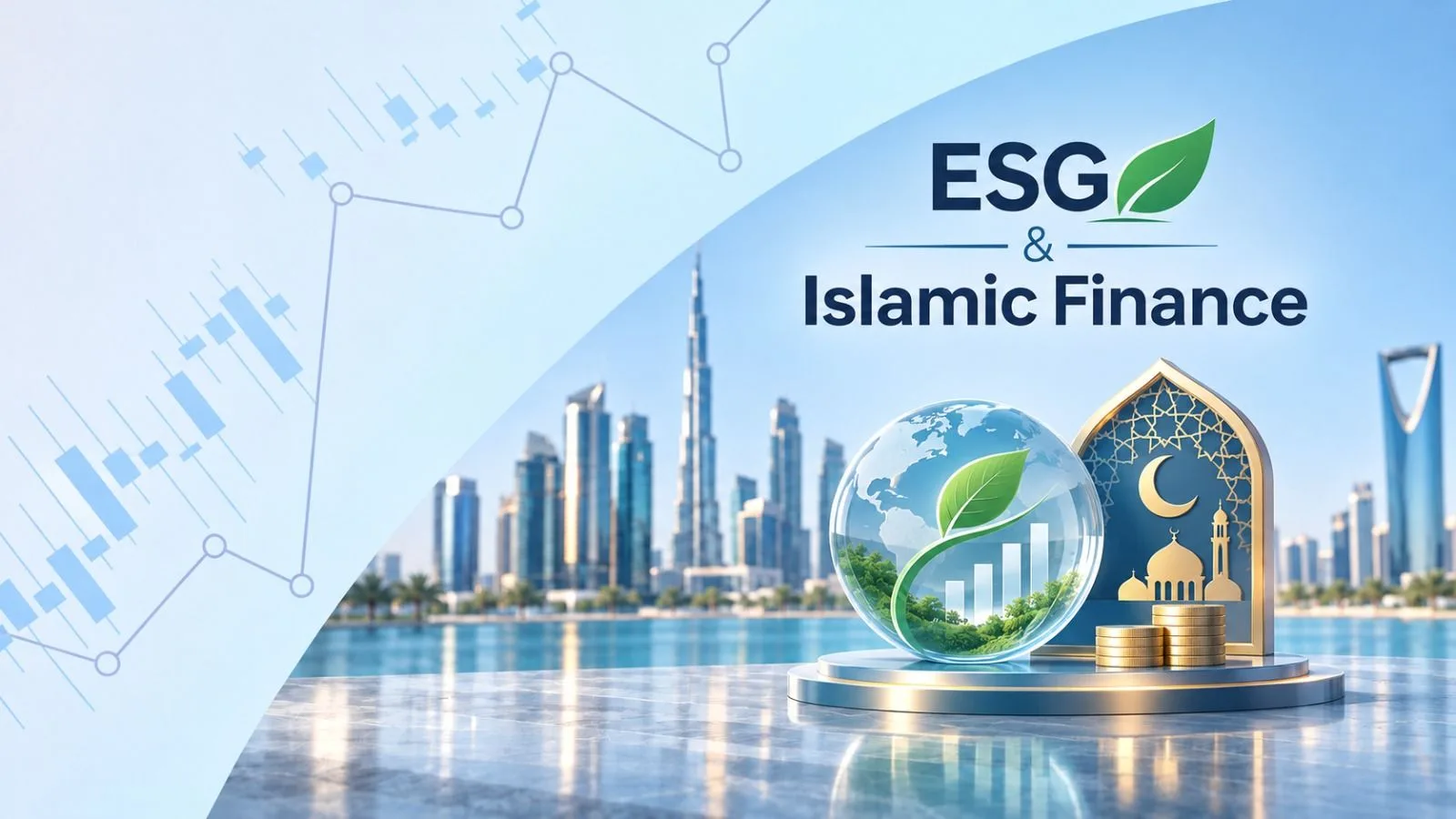
ESG and Islamic finance both claim to put values into investing. They share some of the same exclusions and ethical instincts, so many investors assume an ESG fund must also be Shariah-compliant. It is not so simple. The two frameworks use different tests, and some of the biggest differences are in banking, fossil fuels, and debt.
This guide explains where they overlap, where they diverge, how clean energy funds fit, and what to check before buying. Explore options in Nukoud's ESG and sustainable ETF section.
What Each Framework Tests
ESG investing evaluates companies on environmental, social, and governance factors. Funds either exclude sectors, such as tobacco, weapons, or coal, or tilt toward companies with better scores. Methods differ widely between index providers, so two ESG funds can hold quite different stocks.
Shariah-compliant investing applies two kinds of screens.
- Business screens exclude activities considered impermissible, commonly including conventional interest-based finance, alcohol, pork products, gambling and adult entertainment, with some indices also excluding weapons and tobacco.
- Financial ratio screens limit exposure to debt, interest-bearing deposits and interest income, using thresholds that vary by index provider and scholars. A "purification" step may require donating the portion of income deemed impermissible.
Funds also need governance: a Shariah supervisory board to approve methodology and review compliance. Nukoud's guide to Shariah screening criteria explains how negative screening operates.
Where They Overlap
Both approaches tend to avoid:
- Tobacco and, in many cases, weapons
- Gambling and adult entertainment
- Companies with serious governance or ethical controversies
Both also lean toward transparency and long-term thinking. That shared ground explains why "ethical" and "halal" investors sometimes buy the same funds, and why Shariah-compliant indices often score well on some ESG measures.
Where They Diverge
So an ESG fund can hold a conventional bank that a Shariah fund must exclude, and a Shariah fund can hold an oil company that an ESG fund would drop. The answer to "are all ESG ETFs automatically Shariah-compliant?" is no.
A fund that is both needs both sets of screens, or an index built on the overlap. Few funds do this well, and the choice is narrow. Nukoud's guide to 79 Islamic ETFs worldwide tells investors to check the screening rules, the Shariah methodology, and whether qualified scholars reviewed the structure, custody, and trading mechanism.
Where Clean Energy Fits
Clean energy funds hold companies in solar, wind, storage, grid equipment, electric vehicle supply chains, and related areas. They suit investors who want direct exposure to the energy transition.
For Shariah investors, clean energy can fit, but it is not automatic.
- Business activity is usually permissible, as the activity is generating power or making equipment.
- Debt is a problem. Renewable developers and utilities often carry heavy debt to finance long-lived projects, which can exceed Shariah debt thresholds. Many clean energy stocks therefore fail the financial screens, and a compliant version of the theme may hold a narrower set of companies.
- Interest sensitivity. Because clean energy projects depend on cheap financing, these stocks can react sharply to rate moves. After the September 2026 hike, higher rates are a headwind for debt-heavy companies. See our Fed rate guide.
Because Shariah screening can remove the most indebted names, a Shariah clean energy fund may differ materially from a standard clean energy fund in holdings and risk.
Do ESG and Shariah Funds Underperform?
The evidence is mixed, and it depends on the period, the index, and the screens.
- Exclusions change sector weights. Excluding banks, for example, cuts exposure to a large part of many indices. Excluding energy cuts another. In some periods, excluded sectors outperform and in others lag. The result is a sector tilt more than a structural penalty.
- Thematic funds are volatile. Clean energy funds have had large swings, with strong rallies and deep falls, and short histories make comparisons difficult.
- Costs are higher. Thematic and specialist funds usually charge more. Nukoud's fee study found thematic ETFs average an expense ratio of 0.63%, and ETFs launched in 2025 averaged a record 65 basis points.
- Tracking differences. Always compare a fund with its own index and a relevant benchmark, rather than with the headline market.
We do not cite performance numbers here because they depend on dates and funds. Check each fund's factsheet for returns after fees, volatility and drawdowns over several periods, and treat short windows with scepticism.
Green Sukuk and Fixed Income
Green sukuk are Shariah-structured instruments whose proceeds fund environmental projects. They offer a way to combine the two frameworks in fixed income. The universe is limited. Nukoud's sukuk research notes that Islamic fixed income ETFs are a thin category, calling it "one of the weakest parts of the universe," and its sukuk theme lists only eight Shariah-compliant sukuk ETFs, with expense ratios from 0.40% to 0.75%.
Sukuk ETFs also carry duration risk. The Lunate JP Morgan Global Sukuk ETF has a duration of 4.68 years, so a one-point rise in yields could cost roughly 4.7% in price, before income. Check whether a green label changes risk, which it generally does not. Read our sukuk vs bond ETF guide.
How to Choose: A Checklist
- Define your priority. Is Shariah compliance mandatory, or is it ESG with a halal preference? The answer decides which screen leads.
- Read the methodology. Look for the index provider, screens, thresholds, and purification process.
- Check the board. Confirm a Shariah supervisory board and ask for its certificate.
- Review holdings. Look at the top ten and sector weights. Check concentration in a few names.
- Compare costs. Include the expense ratio and spread.
- Look at liquidity. Small funds can have wide spreads.
- Check domicile and tax. US-domiciled funds default to 30% dividend withholding for non-US investors, and Irish UCITS funds holding US equities commonly face 15% at fund level, per Nukoud. See our expat tax guide.
- Position size. Treat thematic funds as satellites. See core-satellite investing.
Where to Buy ETFs in Saudi Arabia and the UAE
Investors in Saudi Arabia and the UAE can access domestic and international exchange-traded funds (ETFs) through several brokerage platforms. These include traditional investment firms and digital trading platforms, with access varying by market, ETF listing,g and product structure.
Saudi Arabia
United Arab Emirates
Investors should distinguish between buying ETF units directly and trading ETF contracts for difference (CFDs). Direct ownership gives investors an interest in the fund, while CFDs provide exposure to price movements without ownership of the underlying ETF. Before investing, check product availability, regulatory permissions, trading commissions, currency conversion charges, custody arrangements, and the broker's terms.
Greenwashing and Halal-washing
Labels do not guarantee substance. ESG funds can hold companies with weak environmental records, and some "Islamic" labels lack independent oversight. Be careful with names, marketing, and one-line claims. Read the factsheet and prospectus, and check whether the Shariah board is named and independent.
Bottom Line
ESG and Shariah investing share a values-based starting point but use different tests. Clean energy can fit both, but Shariah debt screens may limit the choices, and clean energy funds are volatile and rate-sensitive. If compliance matters, put the Shariah screen first, check the board, then evaluate ESG features as an additional layer. This article is educational and not investment or religious advice. Download our sustainable investing report for more.
Frequently Asked Questions
Are all ESG (Environmental, Social, Governance) ETFs automatically Sharia-compliant?
No. ESG funds may hold conventional banks, insurers, or companies with high debt that Shariah screens exclude. Check the fund's Shariah methodology and board approval.
Do ESG ETFs underperform broad benchmark funds due to stock exclusion?
Not necessarily. Exclusions change sector weights, so results depend on which sectors lead in a given period. Compare returns after fees against the fund's own index over several time frames.
How do green Sukuk ETFs fit into a sustainable investment mandate?
Green sukuk funds finance environmental projects within a Shariah structure, offering a fixed-income route to both goals. The universe is small, and duration and liquidity risks still apply.
What are the screening criteria used to clear stocks for Islamic ESG funds?
Funds typically apply business screens, which exclude activities such as conventional finance, alcohol and gambling, and financial ratio screens on debt and interest income, sometimes with purification. ESG overlays then add environmental, social, and governance criteria.
Why do some clean energy stocks fail Shariah screens?
Many carry high debt to finance projects, which can exceed financial ratio thresholds.
Are clean energy ETFs more volatile than the broad market?
They often are, because they are narrow, rate-sensitive,e and driven by policy and sentiment. Check drawdown history.
Who decides whether a fund is Shariah-compliant?
A Shariah supervisory board of qualified scholars reviews the index methodology, screening, and operations. Ask for the board's certificate.
Can I hold an ESG fund and a Shariah fund together?
Yes, but check for overlap and ensure the combination meets your compliance needs. The Shariah fund should provide the compliance, not the ESG fund.
What is purification?
The process of donating the portion of a fund's income that comes from impermissible sources.