
The Shariah-compliant ETF list is larger than most retail guides suggest, but it is still small, concentrated, and incomplete.
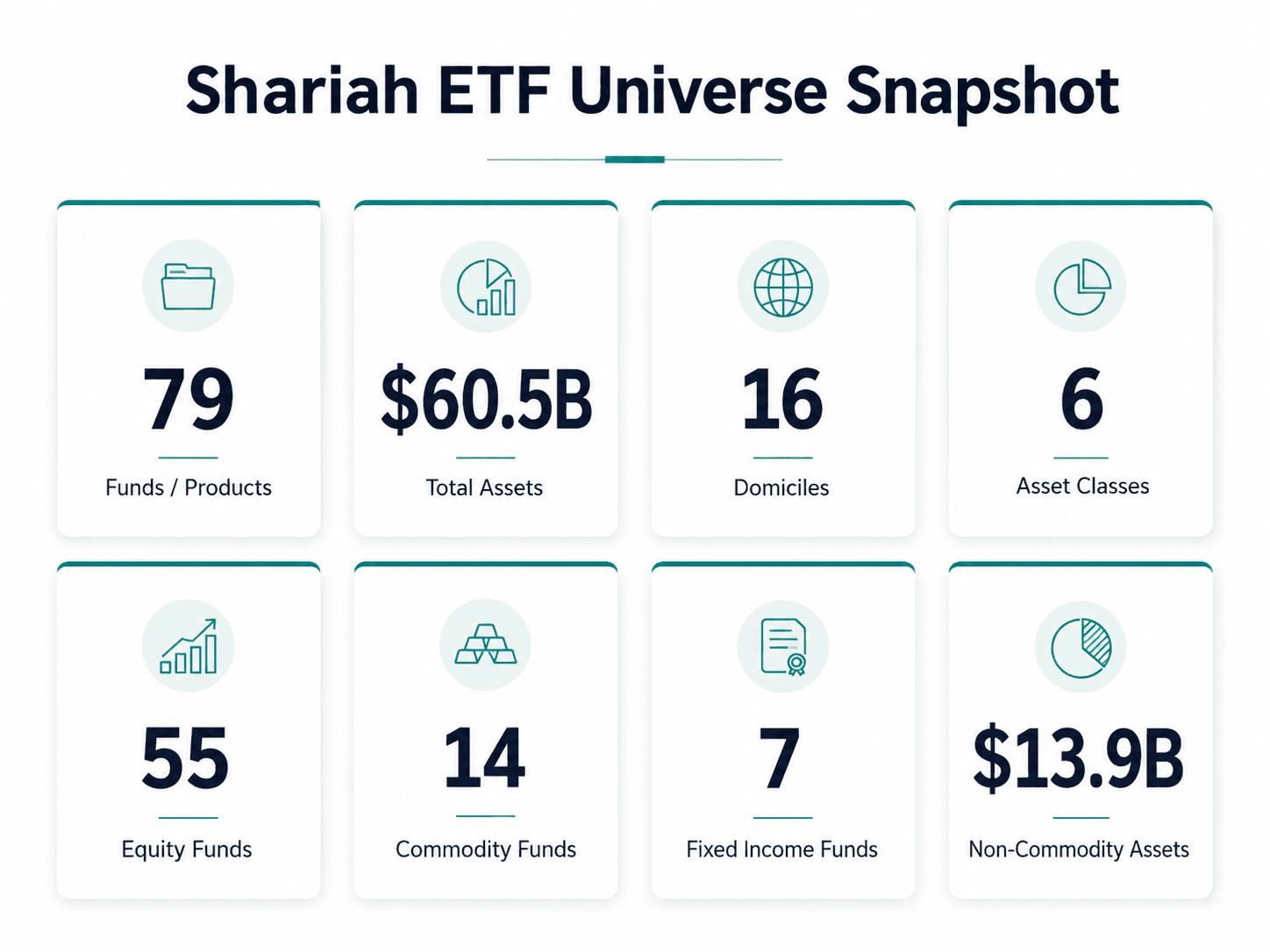
Currently there are 79 Shariah-compliant ETFs and ETPs with around $60.5 billion in assets across 16 domiciles and six asset classes. On paper, that sounds like a meaningful market. In practice, the universe is still narrow. Around 77% of total assets sit in commodity products, mostly gold and precious-metal ETPs.
The Shariah-compliant ETF or halal investment funds market exists, but it is not yet a complete portfolio ecosystem. Investors can access gold, global equities, U.S. equities, some sukuk, and a growing number of regional equity products. But the market remains light in fixed income, income strategies, real estate, multi-asset solutions, cash-like products, and low-cost regional building blocks.
The Market Is Still Small
The global ETF industry has crossed $23 trillion in assets. Against that, the Shariah-compliant funds universe at around $60.5 billion, represents less than 0.3% of global ETF assets.
Islamic finance is a global industry, Muslim investors represent a large and growing investment audience, and ETFs have become one of the most important vehicles for low-cost portfolio construction. Yet Shariah-compliant ETFs remain a very small corner of the global ETF market. Which indicates an early market to explore.
The Universe Is Broad by Count, But Concentrated by Assets
The first thing to understand is the difference between fund count and asset scale.
Equity products dominate by number the Shariah compliant ETFs list. There are around 55 equity funds, making equity the largest category by product count. But those equity funds hold only around $11.7 billion, or roughly 19% of total assets.
Commodities tell the opposite story. There are only 14 commodity products, but they hold around $46.7 billion, or roughly 77% of the universe. This is mainly driven by large physical gold and precious-metal products.
Fixed income and sukuk remains small. There are around 7 fixed-income products, with around $1.2 billion in assets. Real estate and multi-asset exposure are almost absent.
This is the market’s biggest imbalance: halal investors may see nearly 80 products, but most of the capital is concentrated in one asset class.
Commodities Still Dominate the Asset Base
The biggest product in the Shariah-compliant fund list is Invesco Physical Gold ETC, with around $26.5 billion in assets. Other large products include WisdomTree Physical Gold, WisdomTree Physical Swiss Gold, WisdomTree Physical Silver, and WisdomTree Core Physical Gold.
The key word is physical. For halal investors, the structure matters as much as the asset itself. A gold or silver product is generally easier to assess when it is backed by real, allocated metal held in custody, rather than exposure created synthetically through derivatives or unsecured financial contracts.
That links back to core Islamic finance principles: the investment should be tied to a real underlying asset, ownership should be clear, and the structure should avoid riba interest, excessive uncertainty or gharar, and speculation or maysir. Physical commodity products can fit more naturally within that framework, but only when the custody, ownership, redemption, and trading mechanics have been reviewed and approved by qualified Shariah scholars.
This helps explain why commodity products, especially gold, make up such a large share of the Shariah ETF universe. Gold products are important, and for many Muslim investors they are a natural Shariah-compliant store of value. But investors should still check whether each product has a Shariah certificate and whether its structure, custody, and trading mechanism have been reviewed by qualified Shariah scholars.
It also explains why the total Shariah ETF universe looks much bigger than the investable portfolio universe actually feels. Gold can play a role in a portfolio, but gold alone does not build a complete portfolio.
Once commodity products are removed, the non-commodity Shariah ETF universe falls to around $13.9 billion. That is the more relevant number for investors looking for diversified equity, sukuk, income, and allocation products.
Digital assets add another layer to the discussion. BlackRock’s iShares Bitcoin Trust ETF (IBIT) has made Bitcoin exposure more accessible through the ETF wrapper, but its place in Shariah portfolios remains debated. Investors need to assess both the ETF structure and the underlying question of whether Bitcoin itself is considered permissible by their Shariah standards.
Assets Are Concentrated Offshore
The second major concentration is domicile.
Ireland has 19 products and around $33.8 billion in assets. Jersey has 7 products and around $17.4 billion. Together, they account for roughly 85% of the total assets in the dataset.
This is largely because many of the largest UCITS and commodity products are domiciled in Ireland and Jersey. These are important markets for ETF infrastructure, cross-border distribution, and exchange-traded commodity products.
By contrast, Muslim-majority markets have a more limited asset scale. Saudi Arabia has 11 products and around $1.8 billion in assets. The UAE has 11 products but only around $238 million. Malaysia has 7 products with around $261 million. Qatar, Turkey, Pakistan, Nigeria, and other markets remain much smaller.
Product Launches Have Accelerated Since 2020
The Shariah-compliant ETF universe is still being built.
Since 2020, 51 products have launched, representing around 65% of the full universe by fund count.
The most active years were 2020, with 11 launches, 2022, with 13 launches, and 2024, with 9 launches. There were also 5 launches in 2026.
The market should not be judged like a fully developed ETF ecosystem. It is closer to an early-stage product category moving into its next phase.
A Few Products Hold Most of the Money
The list is also concentrated at the fund level.
The top 5 products account for around 72% of total assets. The top 10 products account for around 84%. Many of the largest products are gold, silver, or broad global equity funds.
This concentration creates a gap between headline size and practical depth. A market can have $60 billion in assets, but if most of that capital sits in a few commodity products, investors still do not have enough diversified tools to build complete portfolios.
The largest non-commodity products include funds such as SP Funds S&P Sharia Industry Exclusions ETF, iShares MSCI World Islamic UCITS ETF, Albilad CSOP MSCI Hong Kong China ETF, and Invesco Dow Jones Islamic Global Developed Markets UCITS ETF. These products show that equity demand exists, but the universe remains heavily dependent on a small number of issuers and strategies.
Why We Need More Shariah-Compliant ETFs
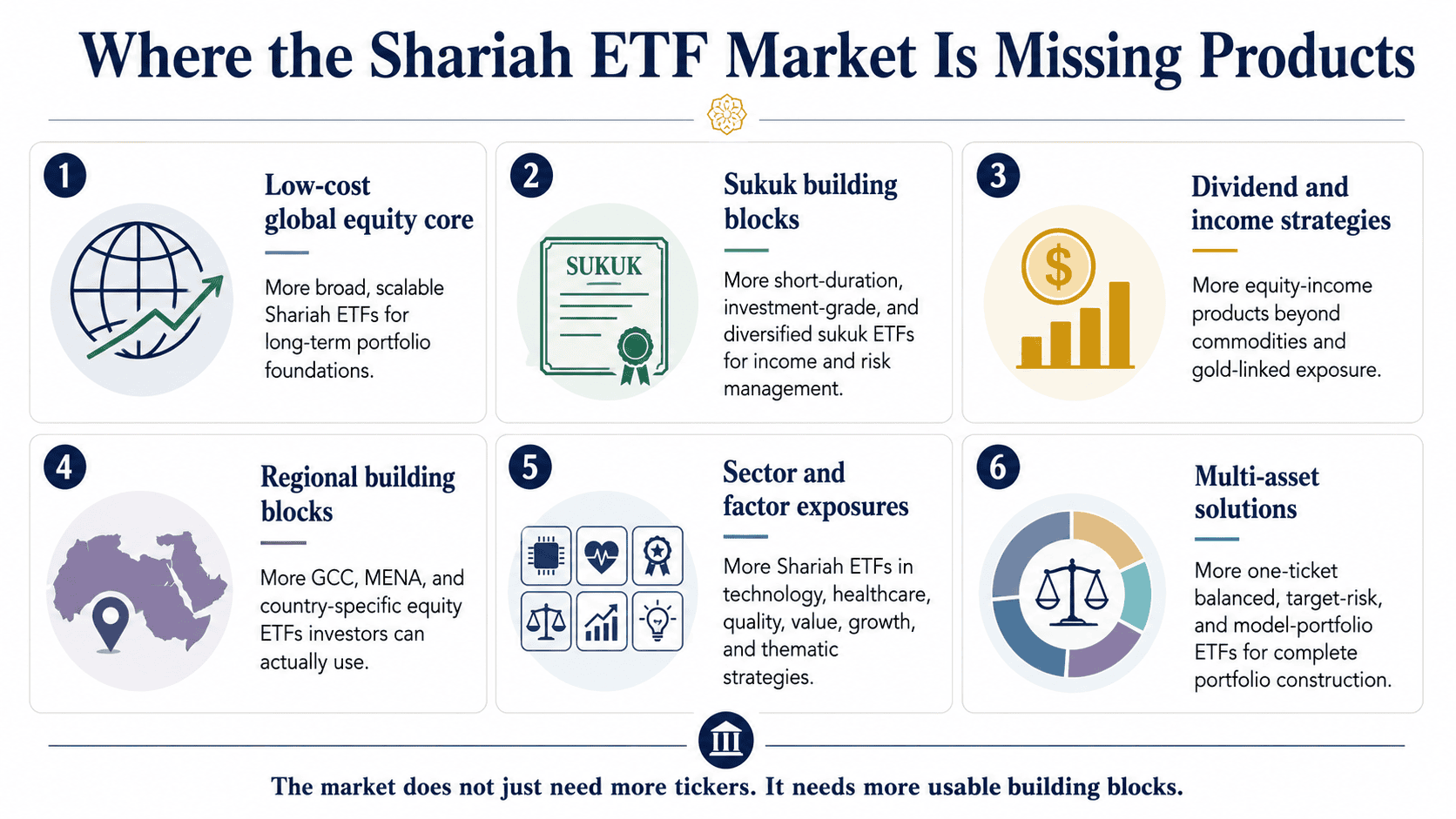
The market does not need more Shariah ETFs just for the sake of more tickers. It needs better products in the categories that matter most for portfolio construction.
First, the market needs more core equity building blocks. There are global and U.S. Shariah equity ETFs, but the market still needs more low-cost choice across global, U.S., emerging-market, GCC, and country-specific exposures.
Second, the market needs more fixed-income and sukuk products. Fixed income is one of the weakest parts of the universe. There are only 7 fixed-income products in the dataset, with around $1.2 billion in assets. For Muslim investors who want balanced portfolios, this is a major limitation.
Third, the market needs more income strategies. Dividend ETFs, sukuk income ETFs, short-duration sukuk, and diversified income products could become major categories. The launch of new GCC dividend products shows that income is one of the most important opportunities.
Fourth, the market needs more regional exposure. Saudi Arabia, the UAE, Qatar, Malaysia, Turkey, and other Islamic finance markets should have deeper ETF ecosystems. Local investors need simple ways to access their own markets without buying individual stocks.
Fifth, the market needs more multi-asset products. One of the biggest gaps is the lack of simple Shariah-compliant allocation funds that combine equities, sukuk, commodities, and cash-like exposure in one vehicle.
The Opportunity for Issuers
The opportunity is to build the missing infrastructure for Muslim investors.
This is where the market can grow, through better portfolio tools.
Final thoughts
The Shariah-compliant ETF universe includes 79 products and around $60.5 billion in assets today. But the market is still far from complete.
Most assets remain concentrated in commodities. Most scale sits offshore. Equity products have grown, but fixed income, income strategies, real estate, and multi-asset solutions remain underbuilt.
That is why the next phase of Shariah ETFs should be about building the missing portfolio infrastructure for Muslim investors: diversified, low-cost, transparent, liquid, and usable across real portfolios.
Investors should also be careful with commodity ETFs. A commodity exposure is not automatically Shariah-compliant just because the underlying asset is gold or another physical commodity. Investors should check whether the product has a clear Shariah certificate, who issued it, and whether the fund structure, custody, and trading mechanism have been reviewed by qualified Shariah scholars.
The demand is already there. The product set still needs to catch up.
Below is the list of all Shariah Compliant ETF funds
Equity Shariah-Compliant ETFs
Commodity Shariah-compliant ETFs
Other Shariah Compliant ETFs
Frequently Asked Questions
What is a Shariah-compliant ETF?
A Shariah-compliant ETF is an exchange-traded fund that follows Islamic finance rules. It avoids prohibited sectors such as alcohol, gambling, pork, and conventional finance, and applies financial screens for debt, interest income, and non-compliant revenue.
Are Shariah ETFs the same as halal ETFs?
Yes. Shariah-compliant ETFs, halal ETFs, and Islamic ETFs are commonly used to describe funds that invest according to Islamic finance principles.
How big is the Shariah ETF market?
The Shariah-compliant ETF and ETP universe includes 79 products with around $60.5 billion in assets across 16 domiciles and six asset classes.
Why do commodities dominate Shariah ETFs?
Commodities dominate because many large Shariah-compliant products are physical gold and precious-metal ETPs. These products are typically backed by real allocated metal held in custody.
Are all gold ETFs Shariah-compliant?
No. A gold ETF is not automatically Shariah-compliant. Investors should check whether it is physically backed, whether ownership and custody are clear, and whether the structure has a Shariah certificate.
Are Bitcoin ETFs Shariah-compliant?
Bitcoin ETFs remain debated. Products such as BlackRock’s iShares Bitcoin Trust ETF make Bitcoin easier to access, but investors must assess whether Bitcoin itself is permissible under their Shariah standards.
What are the main gaps in the Shariah ETF market?
The main gaps are sukuk, fixed income, income strategies, real estate, regional ETFs, cash-like products, and multi-asset allocation funds.
Why do investors need more Shariah-compliant ETFs?
Muslim investors need more Shariah-compliant ETFs to build diversified, low-cost, transparent portfolios across equities, sukuk, commodities, income, and regional markets.
What should investors check before buying a Shariah ETF?
Investors should check the Shariah methodology, Shariah board, screening rules, purification process, fees, liquidity, assets, domicile, index provider, and whether the fund fits their portfolio.