


For years, tokenization was largely viewed as a crypto-native experiment tied to speculative digital assets and decentralized finance. That narrative is changing rapidly. The latest sign came this week as the Depository Trust & Clearing Corporation (DTCC), the institution sitting at the core of the U.S. financial system’s post-trade infrastructure, confirmed plans to begin limited production trading of tokenized securities in July 2026 before a broader rollout later in the year.
The significance lies not just in the technology itself, but in who is adopting it. DTCC is effectively the plumbing of Wall Street: nearly every U.S. stock trade, ETF transaction, corporate bond settlement, and Treasury transfer ultimately passes through its infrastructure. In 2025 alone, DTCC processed securities transactions worth more than $3 quadrillion and held custody of over $114 trillion in assets, making it one of the most systemically important institutions in global finance.
That scale gives the announcement unusual weight. Tokenization is no longer being tested solely by crypto startups or niche fintech firms; it is increasingly being embedded into the infrastructure layer of traditional capital markets themselves.
Under the initiative, DTCC’s subsidiary, The Depository Trust Company (DTC), will allow tokenized representations of traditional securities including Russell 1000 equities, major index ETFs, and U.S. Treasuries to move across approved blockchain networks while maintaining the same investor protections and ownership rights as conventional securities.
From Bitcoin ETFs to Tokenized Markets
Many market participants point to the approval and operational integration of spot Bitcoin ETFs in early 2024 as a key turning point for institutional crypto adoption. Those launches forced traditional financial infrastructure providers, custodians, authorized participants, and exchanges to accommodate digital asset-linked products within regulated frameworks.
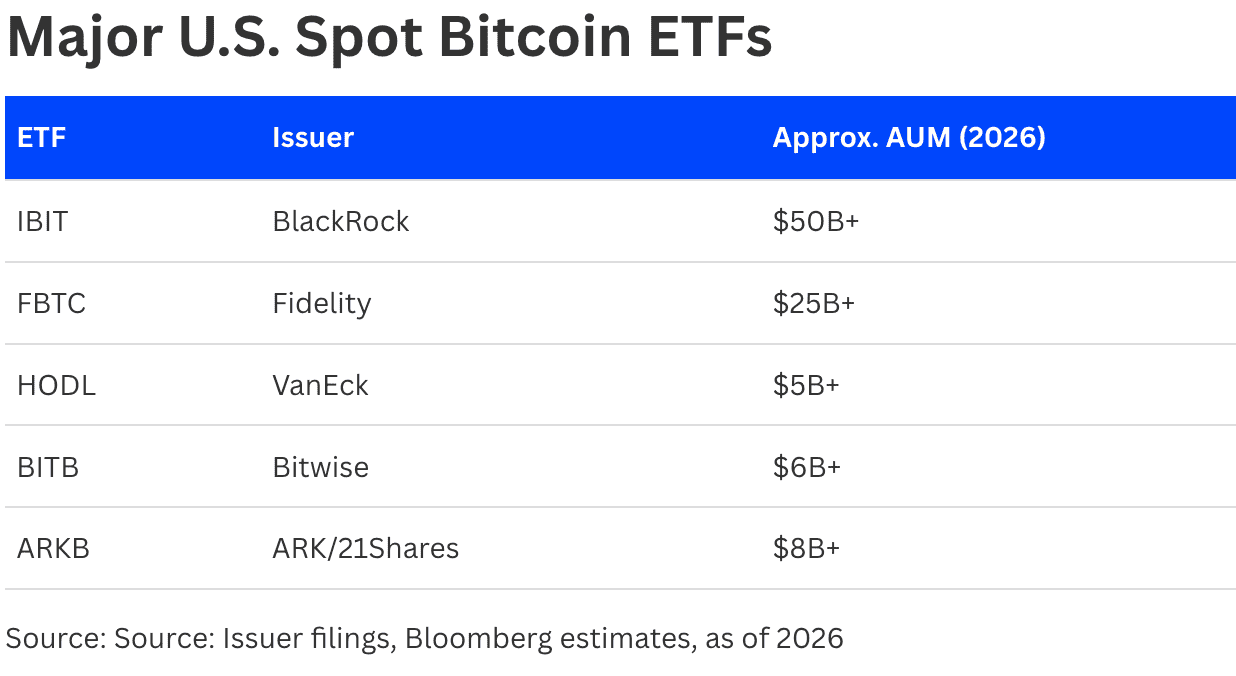
BlackRock’s iShares Bitcoin Trust (IBIT) became the fastest-growing ETF launch in industry history, surpassing $10 billion in assets in less than two months and later crossing $50 billion in AUM within its first year. Products from BlackRock, Fidelity Investments, VanEck, Bitwise Asset Management, and ARK Invest collectively transformed Bitcoin ETFs from a niche experiment into one of the strongest asset-gathering stories in ETF history.
Major U.S. Spot Bitcoin ETFs
The success of those ETFs accelerated institutional comfort with blockchain-based financial infrastructure more broadly.
Wall Street Is Moving Beyond Crypto Speculation
The DTCC initiative reflects a broader institutional transition toward tokenized finance. BlackRock, Franklin Templeton, JPMorgan Chase, BNY Mellon, and State Street Global Advisors have all accelerated blockchain-based projects tied to money-market funds, Treasury settlement, collateral management, and tokenized deposits over the past year.
State Street’s latest initiative illustrates the shift clearly. Earlier this month, State Street Investment Management partnered with Galaxy Digital to launch SWEEP, a tokenized liquidity fund allowing institutional investors to move stablecoins into yield-bearing Treasury-style assets across blockchain networks 24/7. The structure was less about crypto speculation and more about operational efficiency, cash management, and settlement infrastructure.
That distinction matters because Wall Street’s version of tokenization looks very different from the early decentralized-finance narrative. Rather than attempting to replace traditional financial systems, firms are increasingly embedding blockchain rails inside regulated custodial and settlement frameworks.
The core idea is operational efficiency. Traditional financial markets remain constrained by settlement windows, fragmented collateral systems, banking-hour limitations, and multiple intermediaries. Tokenization aims to reduce those frictions by allowing assets and cash to move in near real time across shared digital infrastructure.
DTCC argues the potential benefits include greater collateral mobility, programmable settlement, faster transfers, and eventually round-the-clock market functionality. The organization has also convened more than 50 financial institutions as part of an industry working group shaping operational standards and interoperability across blockchain networks.
The Risks Have Not Disappeared
Tokenization continues to face unresolved questions around liquidity, interoperability, regulation, cybersecurity, and operational concentration. Academic research has shown that many tokenized real-world assets still suffer from thin secondary-market liquidity despite the promise of 24/7 tradability.
At the same time, the broader crypto market remains highly cyclical and sentiment-driven. Institutional adoption does not eliminate volatility.
The Bottom Line
What began as experimental blockchain pilots is steadily evolving into institutional financial infrastructure development. Increasingly, the institutions driving the transition are not crypto-native startups, but the firms already operating the global financial system itself.
For investors in the GCC, the implications extend well beyond cryptocurrency exposure. Abu Dhabi and Dubai have both positioned themselves around tokenization, digital assets, and blockchain-based finance as part of broader capital-market modernization strategies.
If tokenized securities become embedded into mainstream settlement and custody systems, the impact could eventually extend across ETFs, collateral management, cross-border settlement, and global capital flows.
The key takeaway is that tokenization is no longer just a crypto story. It is increasingly becoming a market infrastructure story.