
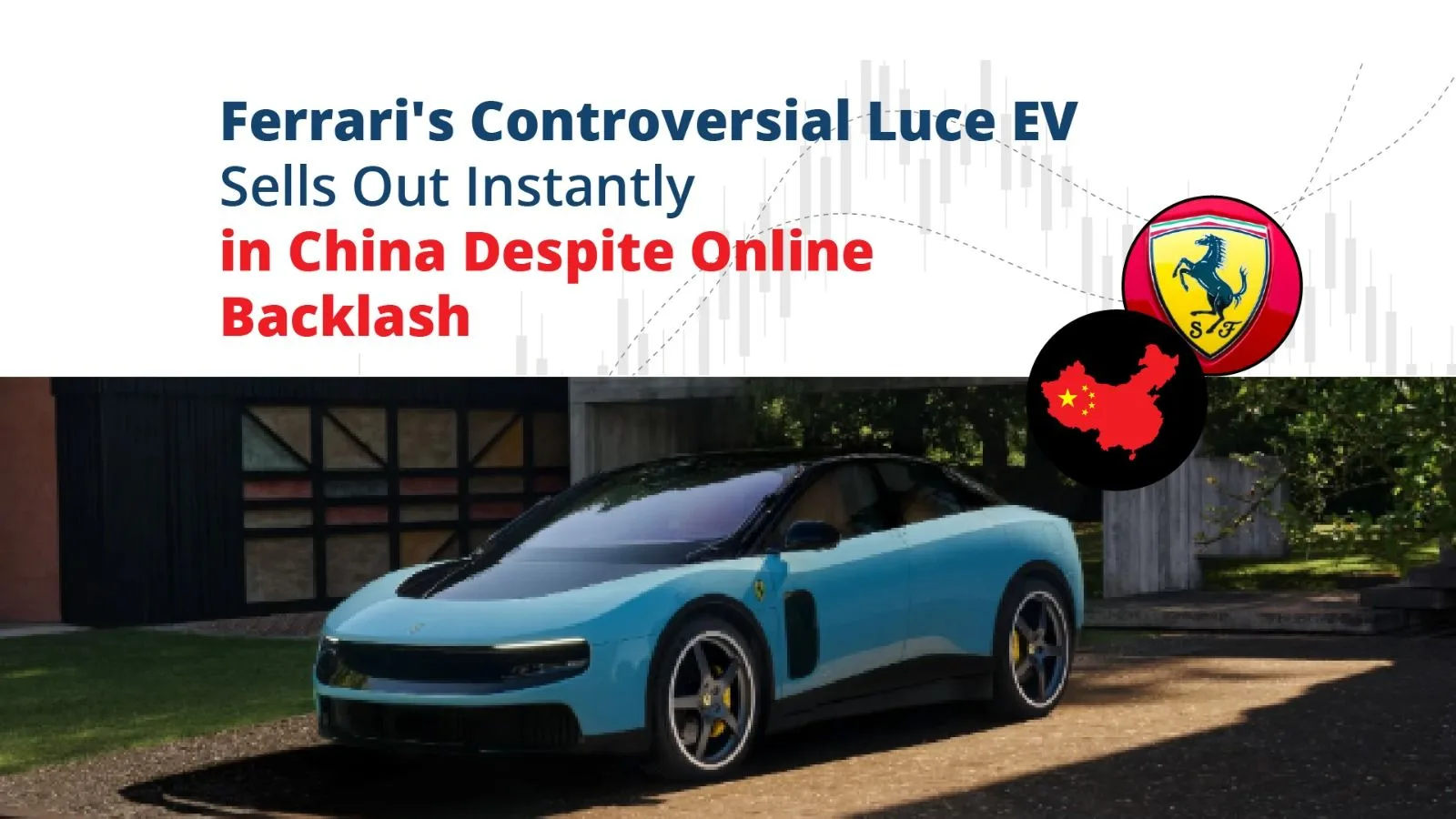
Ferrari's first all-electric production car spent weeks being mocked online for its styling and its decision to ditch the combustion engine altogether. Then, shortly after its launch in China, all 88 units allocated to the market reportedly sold out. The disconnect between social-media sentiment and showroom demand is the real story here, and it says more about who buys Ferraris than it does about the car itself.
The Luce also represents several firsts for Ferrari beyond going electric: it's the brand's first regular-production four-door grand tourer and its first five-seat production car. Its minimalist styling immediately divided opinion, becoming one of the main drivers of the design backlash following its unveiling.
Why Ferrari's Pricing Strategy Worked in China
Ferrari priced the Luce in China at RMB 3,988,000 ($586,992), undercutting its European list price of €550,000 ($626,293) by roughly 7%, an unusual move for a brand that typically charges more in China once import duties and displacement-based luxury taxes are factored in.
The Amalfi comparison matters: Ferrari’s combustion-engine cars normally get more expensive in China, not cheaper. Pricing the Luce below its European tag suggests Ferrari treated the launch as a deliberate market-entry play rather than a standard release, prioritizing penetration and credibility in the world’s largest EV market over margin on its first electric model.
All 88 units reportedly sold out shortly after launch, even as a Beijing dealer reportedly continues taking orders ahead of a July 3–5 launch event, suggesting Ferrari could expand allocations if demand remains strong. With supply capped at 88 cars, the speed of the sellout also reads as Ferrari’s familiar scarcity playbook at work: limited allocation amplifying demand among collectors and ultra-high-net-worth buyers, regardless of how the car was received online.
How the Luce Stacks Up Against China's EV Heavyweights
On paper, the Luce loses the numbers game badly. Two homegrown Chinese rivals, BYD’s Yangwang U9 and GAC’s Hyptec SSR, beat it on power, acceleration, and price by wide margins.
At Hyptec SSR pricing, a buyer could purchase roughly three SSRs for the cost of one Luce. At U9 pricing, the gap is almost exactly 2-to-1. Despite this, there is little evidence that buyers seriously cross-shopped the Chinese alternatives, suggesting the Luce is competing primarily on brand equity rather than outright specifications.
Why Are Buyers Paying More for Less Performance?
Ferrari positions the Luce as a five-seat grand tourer, not a supercar, which partly explains the performance gap versus the U9 and SSR: different mission, different buyer. But the deeper explanation is cultural: Chinese commentary outlet Speedsters described the car as “4 million RMB on wheels,” framing it as an instant signal of membership in China’s wealthiest tier rather than a transportation decision.
That dynamic matters for how the Chinese auto market is evolving. Chinese EV brands have closed and, in cases like the U9 and SSR, exceeded the performance gap with legacy supercar makers. What they haven’t replicated yet is decades of accumulated brand mystique. The Luce sellout suggests that, at the very top of the wealth pyramid, badge prestige is still outperforming the spec sheet.
Did Ferrari Use the Luce to Reward Loyal Customers?
Reports first surfacing via Bloomberg speculated that dealers were using Luce allocations as a gateway product, rewarding buyers with priority access to Ferrari’s more exclusive, harder-to-get models. Ferrari’s then-chief marketing officer denied this directly, stating the car was built for a distinct customer base from the outset. That denial is expected to extend to the Chinese market as well, though the brand has not detailed an alternative explanation for the unusually steep sellout.
Can Ferrari Stay Ahead as Chinese EV Brands Close the Gap?
The China launch follows a turbulent few weeks for Ferrari. The Luce's May reveal triggered enough negative sentiment to push Ferrari's stock down more than 6% in a single trading day. The episode was followed by management changes, with longtime commercial chief Enrico Galliera departing and former BMW Italy executive Massimiliano Di Silvestre taking over the role. Ferrari has also faced increasing competitive pressure in China as domestic premium EV manufacturers rapidly expand into the high-performance segment, while rising ownership costs for luxury ICE vehicles in China add further pressure to legacy combustion models.
Ferrari’s second EV is reportedly not due until 2028, leaving the Luce to carry the brand’s electric narrative alone for several years. The China sellout buys Ferrari time and validates demand for an ultra-luxury EV niche few analysts were confident existed, but as Chinese manufacturers get sharper at marketing emotion alongside engineering, that advantage is unlikely to hold indefinitely without reinforcement.
Ferrari Stock Performance and a GCC Investment Opportunity
Ferrari's shares have remained volatile since the Luce's unveiling. The company's Milan-listed stock fell sharply after the launch as investors questioned demand for Ferrari's first electric model, even though customer orders later proved stronger than expected. While the China sellout has helped improve sentiment, Ferrari's share price remains well below its late-2025 highs, highlighting that investors are still assessing the long-term implications of the company's transition to electric vehicles.
Investors who want exposure to Ferrari without buying the stock directly have a regional alternative: the Boreas S&P Absolute Luxury UCITS ETF (LUXURY.AD), which was listed on the Abu Dhabi Securities Exchange (ADX) in January 2026. The fund holds 32 leading European luxury companies, including Ferrari (RACE) alongside LVMH, Hermès, Richemont, and L'Oréal, giving investors diversified exposure to Europe's luxury sector through a single investment vehicle. Because Ferrari is one of the ETF's constituent holdings, movements in its share price, including the decline following the Luce's unveiling, are reflected in the fund's overall performance, making the ETF a useful, though diversified, way for GCC investors to gain exposure to the luxury automotive segment.
As of June 29, 2026, the ETF’s NAV stood at AED 1.852, up 0.22% on the day. The table below compares the fund’s recent returns against its benchmark, the S&P Europe Luxury 35/20 Capped Index, while posting a 9.8% gain over the past three months, compared with 11.23% for its benchmark index.
The fund has lagged its benchmark since inception, down 9.35% versus the index’s 8.07% decline, though it has clawed back ground over the past quarter with a 9.8% gain. The wider sector backdrop helps explain the drag: European luxury names broadly have been under pressure this year, and the Luce controversy added one more headwind to a sector that was already softening before the China sellout offered a counter-narrative.
Read our related analysis: Hamilton Delivers First Podium as Ferrari Stock Falls on Luce News.
Bottomline
The Luce loses on almost every metric that typically defines a modern performance EV: slower acceleration, less power, and a price several times higher than the Chinese rivals, yet it sold out anyway. That's the headline: at the very top of China's wealth pyramid, Ferrari's badge is still doing more work than its powertrain. The risk is that this may prove to be borrowed time rather than a lasting trend. China's domestic brands are rapidly closing the gap not only in engineering but also in brand perception, while Ferrari has only one production EV, with its next electric model reportedly not expected until 2028, to demonstrate that prestige alone can continue to command such a premium.