
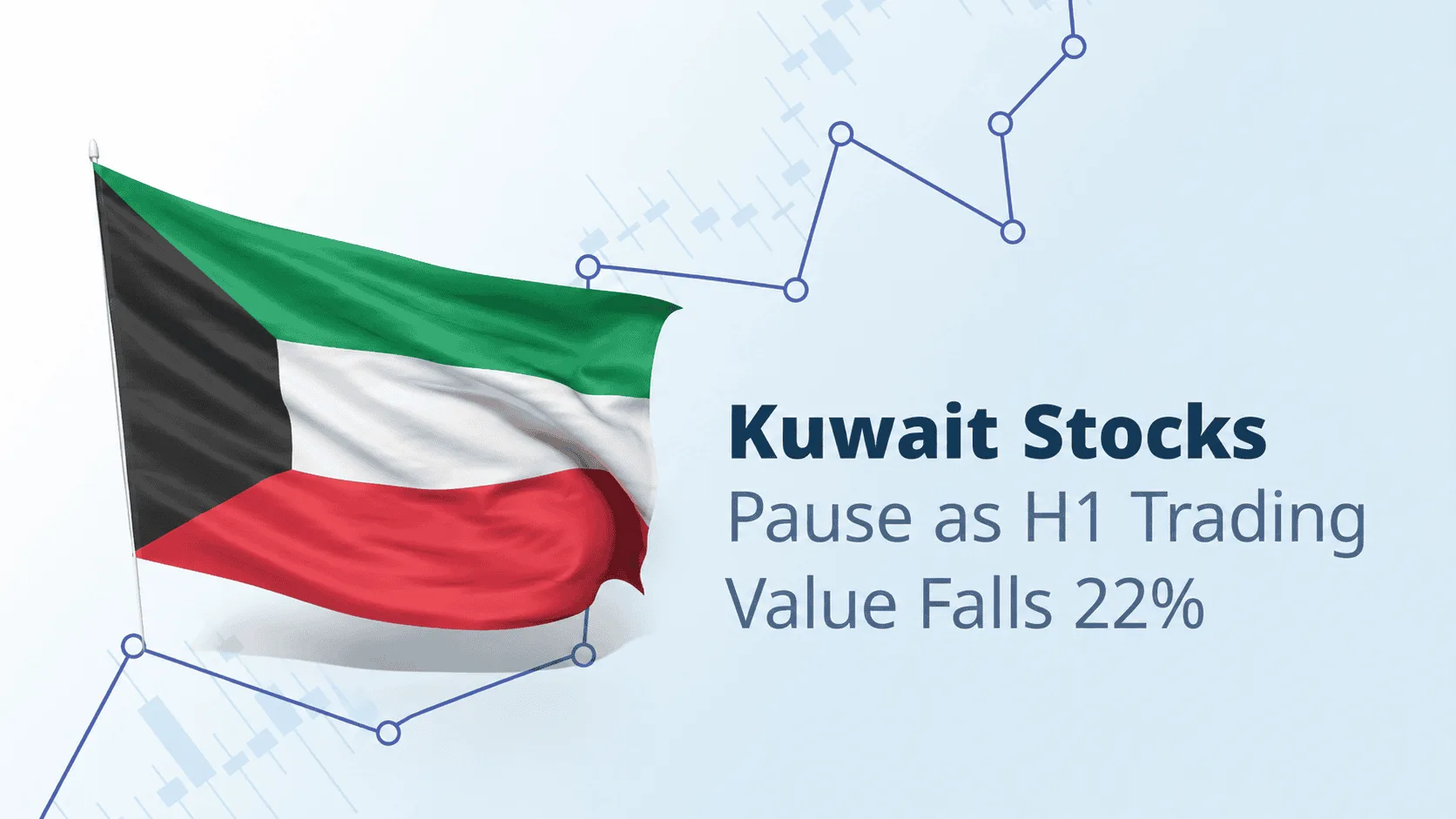
Kuwait’s equity market entered the second half of 2026 with slower turnover, but the data looks more like a temporary pause than a broad loss of confidence. Trading value on Boursa Kuwait reached KD9.82 billion across 116 sessions in the first half, while average daily trading value fell 22.2% year on year to KD84.7 million from KD108.9 million, according to Al-Shall Consulting’s July market report.
Kuwait Investment Company’s monthly report put Boursa Kuwait’s market capitalization at KD53 billion as of 30 June, down KD1.15 billion. Using the Central Bank of Kuwait’s 9 July dollar rate of 307.750 fils per dollar, that decline equals about $3.7 billion, while H1 trading value works out at roughly $31.9 billion.
June Liquidity Offers a Softer Reading
The half-year headline misses an important June detail. Boursa Kuwait liquidity rose 14.9% in June to KD2.13 billion from KD1.86 billion in May, according to QNA, even as average daily trading value eased during the month. The Premier Market Index fell 2.4% in June and the All-Share Market Index lost 1.2%, while the Main Market gained 4.6% and the BK Main 50 rose 1.9%.
That mix points to rotation rather than a uniform exit. For GCC investors, the distinction matters. Kuwait is often used as a defensive regional allocation through banks, telecoms, consumer names and dividend-linked stocks, so weaker turnover affects execution quality before it changes the long-term market case. ETF managers and active funds still need to watch bid-offer spreads, available free float and liquidity concentration, especially when flows move toward a narrow group of names.
Regional Risk Is Still the Swing Factor
Kuwait is being priced inside a wider Gulf risk cycle. Reuters said most GCC markets closed lower on 9 July as renewed US-Iran hostilities weighed on sentiment, with Brent crude at $78.55 a barrel. Dubai fell 0.2%, Abu Dhabi finished flat, Qatar declined 0.8% and Saudi Arabia’s TASI lost 0.4%.
Recent rebounds across ADX and DFM show why the Kuwait move should not be framed as a structural break. In April, Dubai surged 6.9% and Abu Dhabi climbed 2.9% after a US-Iran ceasefire agreement reopened part of the regional risk trade. In June, Dubai rose 2.5% and Abu Dhabi advanced 1.2% on renewed ceasefire optimism.
What GCC Investors Should Watch Next
For Boursa Kuwait, the next test is breadth. A rebound led by large banks would help index performance, but broader turnover across mid-cap and Main Market names would give investors a cleaner signal that June’s liquidity improvement can extend into earnings season.
The useful question for allocators is whether the H1 slowdown reflects caution after a volatile Gulf tape, or whether liquidity is becoming too concentrated for efficient portfolio execution. June’s figures lean toward caution, with selective buying still present. Sustained trading depth in July and August would make the temporary-pause argument stronger.