
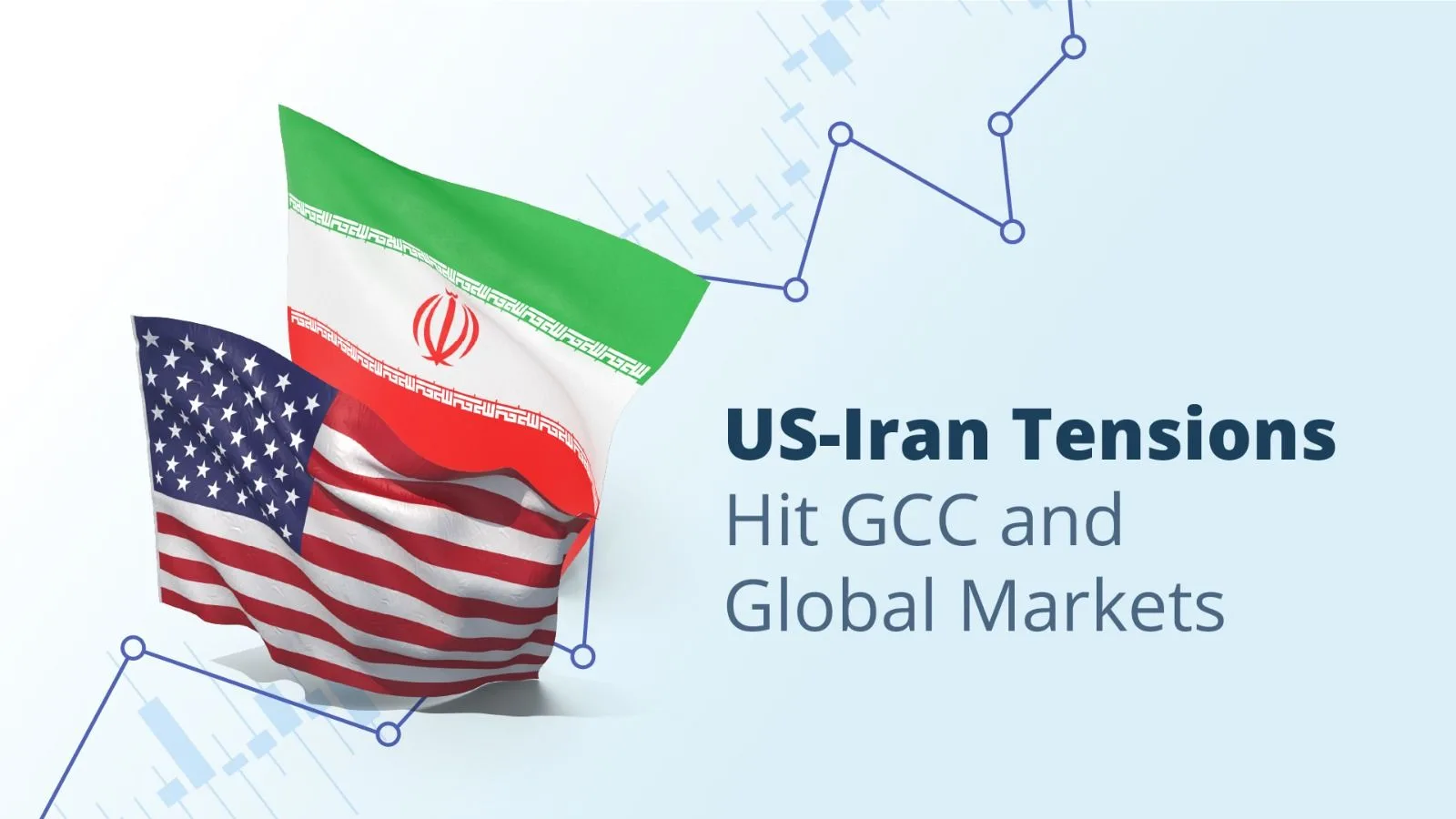
Renewed US-Iran tensions have put GCC markets back on a Hormuz watch, with the first reaction showing up in oil, local equities and long-duration technology trades. Reuters reported on 9 July that fresh US strikes on Iran, followed by Iranian attacks on Kuwait and Bahrain, extended the previous session’s losses across most Gulf exchanges. Brent rose 1.1% to $78.88 a barrel early in the session, while Saudi Arabia’s TASI lost 0.4%, Dubai fell 0.8%, Abu Dhabi slipped 0.5%, and Qatar declined 0.8%.
The trigger is familiar, but the market response is more selective than a panic bid for every haven. Oil’s move was measured rather than disorderly. Brent traded around $77.86 a barrel at 1:38pm Dubai time, down 0.2% on the day, as markets weighed the risk of further escalation against the possibility of diplomatic containment. The Strait of Hormuz remains the key transmission channel with EIA data showing that 20.9 million barrels a day moved through the strait in the first half of 2025, roughly one-fifth of global petroleum liquids consumption.
UAE markets have carried a sharper local risk premium. On 8 July, Dubai Financial Market General Index fell 1.51% to 6,001.93 and was down 1.46% over the two sessions from 6 July, based on Investing.com historical closes. Abu Dhabi’s FTSE ADX General Index lost 0.56% on 8 July and was down 0.38% over the same two-session window. Saudi Arabia has been steadier on a closing basis: TASI ended 9 July at 10,808.52, barely changed from its 6 July close, even though Thursday’s intraday tone was weaker.
Across US-listed ETFs, the shock has hurt growth and thematic risk more than the broad S&P 500 proxy. As of the 8 July close, SPDR S&P 500 ETF Trust fell 0.78% over two sessions, while Invesco QQQ Trust lost 1.57%. The thematic damage was wider: Global X Artificial Intelligence & Technology ETF fell 1.99%, robotics-heavy BOTZ lost 5.91%, Defiance Quantum ETF dropped 2.85%, and SPDR Gold Shares declined 2.01%. These are price returns, calculated from Investing.com closes, and exclude distributions.
That pattern says the market is treating the conflict as an inflation and rates shock as much as a geopolitical shock. Reuters reported spot gold down 0.9% on 8 July and US gold futures down 1.8%, as higher oil prices fed rate-hike expectations and reduced the appeal of a non-yielding asset. For AI and quantum ETFs, the pressure is more mechanical. Higher yields tend to compress valuations on long-duration growth themes, while any chip, cloud or supply-chain concern can turn crowded thematic exposure into a faster-moving trade.
For UAE and GCC institutions, the portfolio issue is exposure mapping rather than headline reaction. Local equities carry direct sensitivity through banks, aviation, insurance, real estate liquidity and consumer confidence. Global ETFs add dollar-rate exposure and US tech concentration. Product domicile remains part of the risk budget: US-source income paid to nonresident aliens can face 30% withholding unless a treaty or exemption applies, according to the IRS, so UCITS equivalents may deserve comparison where liquidity, tracking and mandate rules permit.
Sharia-sensitive mandates also need security-level screening in AI and quantum baskets, since thematic labels do not settle revenue, leverage or business-activity tests. The next data points are Hormuz traffic, Brent’s ability to hold inside the $75 to $85 range cited by WisdomTree in Reuters, liquidity on ADX and DFM, and Fed pricing after the oil move. The risk has moved from distant geopolitics into portfolio plumbing.