
Saudi equities rebounded strongly in August, with the Tadawul All Share Index rising 5.07 percent to a four-month high. Stabilizing geopolitical conditions, elevated oil prices and a supportive second-quarter earnings season improved investor sentiment, while a broader global equity recovery provided an additional tailwind. The rally was led by financial stocks, with Saudi-focused ETFs also posting gains during the month.
Saudi Stocks Rally 5.07% as Banks Drive Tadawul Higher
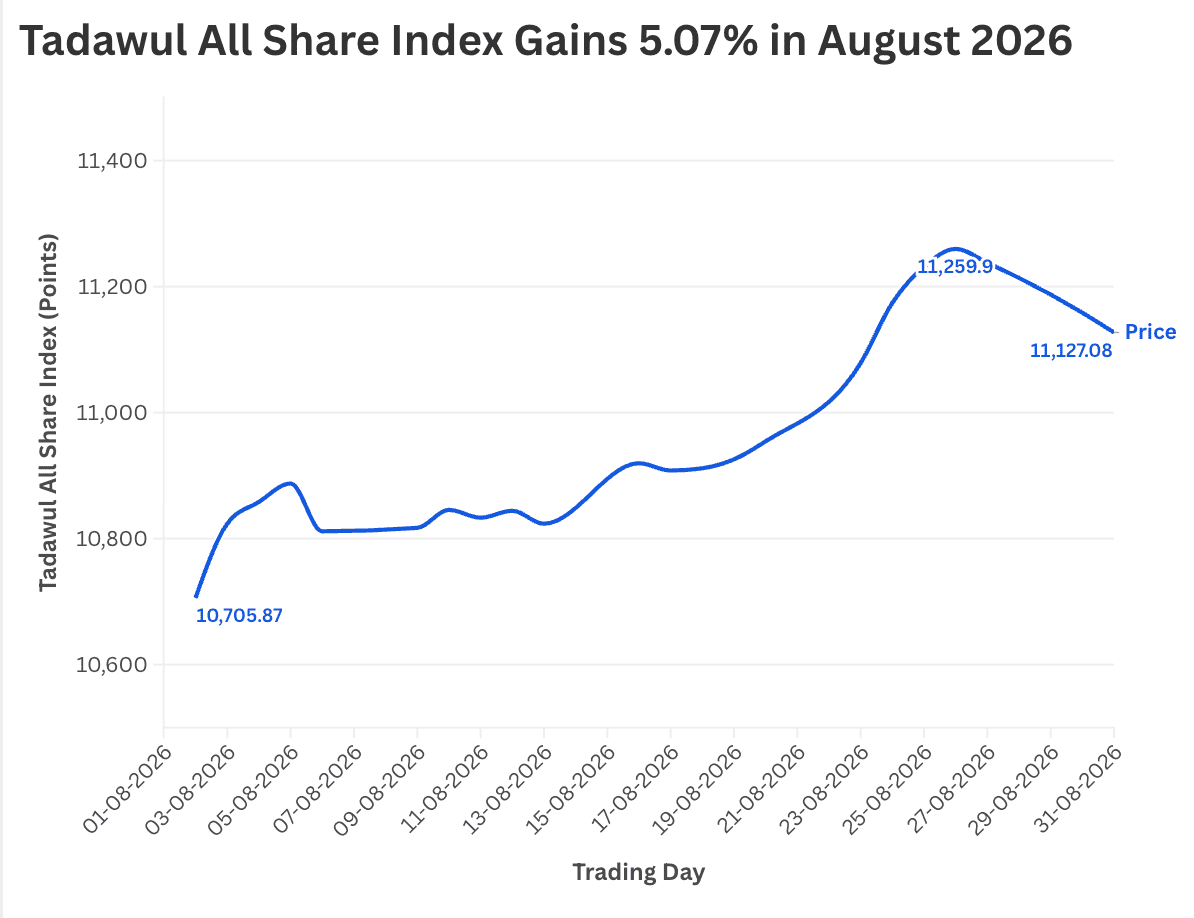
The Tadawul All Share Index rose 5.07 percent in August, closing at a four-month high of 11,127.08 points and lifting its year-to-date gain to 6.07 percent, the best performance of any GCC market for the month.
Banking names were the biggest movers, with Banque Saudi Fransi, Saudi National Bank, and Alinma Bank all posting double-digit monthly gains. That strength was underpinned by fundamentals: Saudi Arabia's 10 listed banks reported combined Q2 net profit of roughly $6.63 billion, up 12.5 percent year-on-year, led by higher financing and investment income. Saudi Aramco fell 1.2 percent despite crude's late-month recovery, highlighting the financial sector's contribution to the index's advance.
Average daily value traded reached SAR 5.11 billion ($1.36 billion), while market capitalization stood at SAR 9.54 trillion ($2.54 trillion) at month-end. Foreign investors held SAR 461.52 billion ($123.07 billion) in Saudi equities.
Oil Prices Support Saudi Equities Despite Market Volatility
Crude played an outsized role in the month's narrative. The U.S. Energy Information Administration raised its third-quarter Brent forecast to roughly $85 a barrel, an $11 upward revision, citing continued constraints on oil shipments through the Strait of Hormuz and their impact on global inventories. Kamco Invest noted Brent rose above $94 a barrel intra-month before settling above $90 by month-end, elevated but volatile. Higher oil prices generally support Saudi fiscal expectations and liquidity conditions, although the impact varies across sectors and companies.
Saudi ETF Performance Varies by Strategy
The August rebound was reflected across Saudi-focused ETFs, although performance varied by strategy.
Broad-Market Saudi Equity ETFs Gain
The Albilad MSCI Saudi Equity ETF (9412) gained 5.79% in August, rising from SAR 9.16 on July 30 to SAR 9.69 on August 31. Its broad Saudi equity exposure, including significant exposure to larger companies and financials, positioned it well for the bank-led Tadawul rally.
The Al Rajhi MSCI Saudi Equity ETF (9413) began trading on August 10 and therefore does not have a full-month performance history. Its NAV reached SAR 10.32 by month-end, compared with its SAR 10 initial offering price. The fund provides Shariah-compliant exposure across large-, mid- and small-cap Saudi companies.
Mid- and Small-Cap Growth Gains
By comparison, the Albilad MSCI Saudi Growth ETF (9408) gained 4.34% during August, rising from SAR 7.84 on July 30 to SAR 8.18 on August 31. With a growth-focused portfolio and greater exposure to mid- and smaller-cap companies, the fund provides a more targeted way to participate in Saudi domestic growth and Vision 2030 themes.
The comparison shows that the broader Albilad Saudi Equity ETF outperformed the Growth ETF by 1.45 percentage points during August, indicating stronger performance from broader Saudi equity exposure during the rally.
For a deeper comparison of the two strategies, see our guide to Albilad MSCI Saudi Equity ETF vs. Albilad MSCI Saudi Growth ETF: Which Saudi Strategy Fits Your Portfolio?
Global Stock Rally Provides Additional Support
GCC markets rallied alongside a broader global uptrend: the MSCI World Index rose 2.6 percent, and the S&P 500 touched a record high mid-month before paring some gains. Global bond markets came under pressure toward month-end after Federal Reserve Chair Kevin Warsh struck a hawkish tone on inflation at Jackson Hole, prompting markets to raise expectations for a September rate increase and pushing Treasury yields higher. Because the Saudi riyal is pegged to the U.S. dollar, changes in U.S. interest-rate expectations can feed through to Saudi funding costs and equity valuations.
What Could Drive GCC Stocks in September?
Oil prices, U.S. interest-rate expectations and geopolitical developments will remain the main catalysts for GCC equities. In Saudi Arabia, continued bank earnings momentum will be important for sustaining the Tadawul's gains, while changes in oil prices could quickly affect investor sentiment and regional liquidity.
Bottom line
Saudi Arabia led the GCC's August rebound, with the Tadawul gaining 5.07 percent as strong bank earnings, elevated oil prices and easing geopolitical tensions improved sentiment. The rally also translated into gains across Saudi-focused ETFs, although performance varied by strategy: the broad Albilad Saudi Equity ETF gained 5.79 percent, outperforming its mid-/small-cap-focused Growth ETF by 1.45 percentage points, while the newly launched Al Rajhi Saudi Equity ETF offers another broad-market option. The key question for September is whether bank earnings momentum and supportive oil prices can sustain the rally as global rate expectations and geopolitical risks remain in focus.