
The iShares MSCI Turkey ETF (TUR) has come under pressure again as investors confront a weaker growth outlook, still-high inflation and renewed stress inside Turkey’s domestic fund industry.
The latest macro setback came from the OECD, which cut its 2026 GDP growth forecast for Turkey to 2.7% from 3.1% and raised its inflation forecast to 31.5% from 28.4%. The OECD also lowered its 2027 growth estimate to 3.6% and lifted its 2027 inflation forecast to 24.7%, citing weaker domestic demand, tighter financial conditions and high energy costs.
Turkey remains one of the more volatile single-country exposures inside emerging markets. Nukoud’s Emerging Markets ETF comparison page currently tracks 36 funds across the U.S., UAE, Saudi Arabia and other markets, including a UAE-listed Turkey strategy.
Fund Stress Has Added to the Pressure
A liquidity crunch forced authorities to intervene on September 17 after redemptions spread across several portfolio managers. The central bank increased repo funding to 300 billion lira, while regulators ordered the liquidation of funds managed by seven portfolio companies, affecting roughly 891 billion lira in assets and 353,000 investors.
Nukoud covered the episode in “Turkish Stocks Limit Down as Crisis Deepens. TURKI ETF Sees Big Volume,” after the BIST 100 fell 5.54% and triggered a circuit breaker as redemption stress spilled into listed equities.
Reuters later reported that the BIST 100 lost more than 8% during the week, its worst decline since March 2025, as managers sold more liquid holdings to meet withdrawals from funds exposed to thinly traded stocks.
The strain has not fully disappeared. On September 28, Turkish equities fell another 2.7%, while the country’s five-year credit-default-swap spread rose to 254 basis points, its highest level since May, as an investigation into market manipulation and investment-fund irregularities continued.
What It Means for Turkey ETFs
The U.S.-listed iShares MSCI Turkey ETF (TUR) gives broad exposure to Turkish equities through the MSCI Turkey IMI 25/50 Index. BlackRock reported 76 holdings, $226.4 million in assets and a 0.59% expense ratio as of September 10. Industrials represented 29.1% of the portfolio, followed by financials at 14.9%, consumer staples at 13.4% and materials at 12.1%.
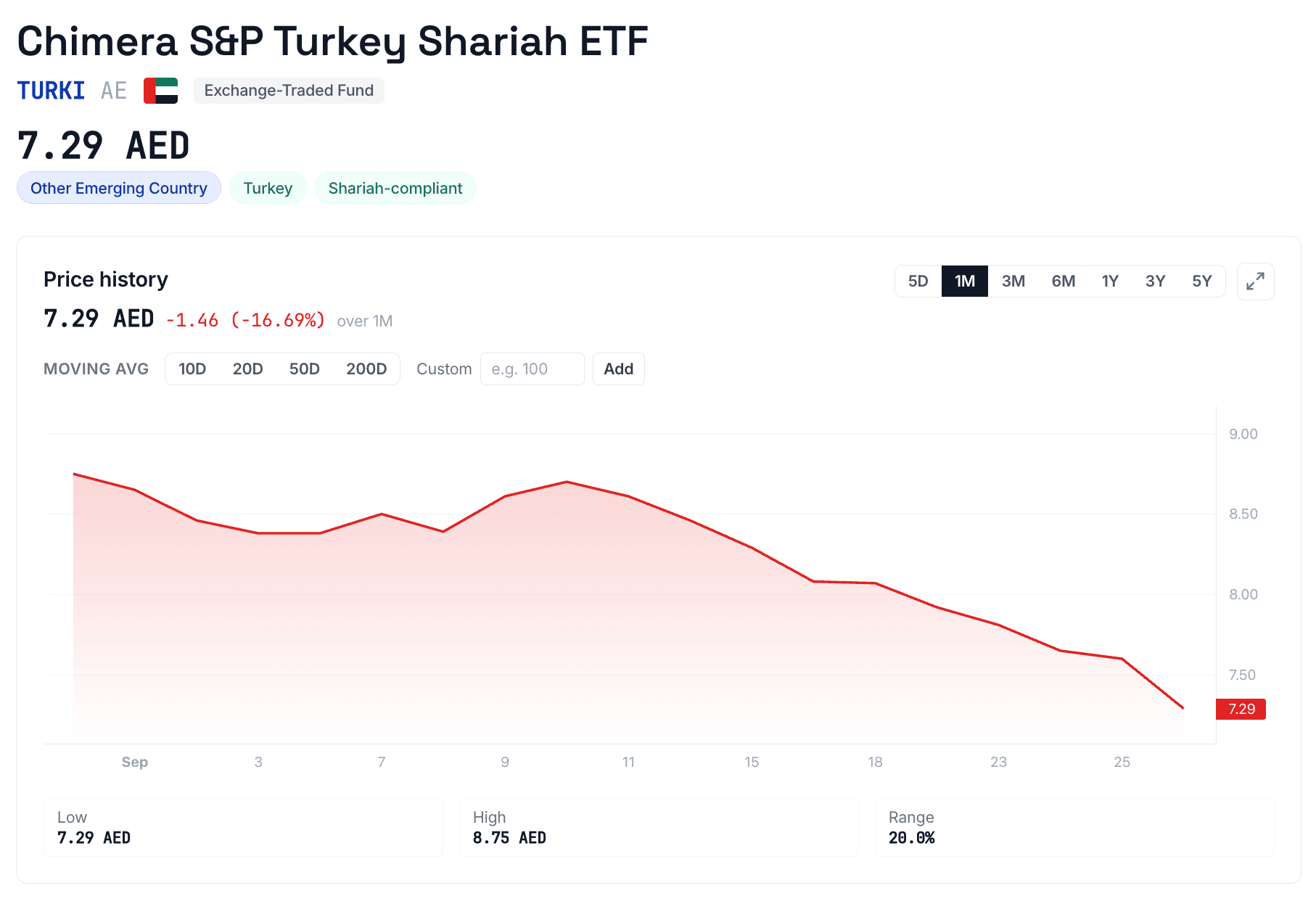
GCC investors also have a local route through the Chimera S&P Turkey Shariah ETF (TURKI), listed on ADX. The fund tracks the S&P Turkey Shariah Liquid 35/20 Capped Index and had AED11.47 million in assets as of September 16, according to Nukoud.
TUR offers broader conventional Turkish equity exposure, while TURKI applies a Shariah screen and concentration caps, so the two funds can react differently even when the broader Turkish market is moving sharply.
Turkey is still growing, but the market now has to absorb slower expected GDP growth, inflation above 30% and renewed concerns around fund liquidity and market structure. For both TUR and TURKI, the next few weeks are likely to remain driven by domestic liquidity, the lira and confidence in the regulatory response rather than by earnings alone.