
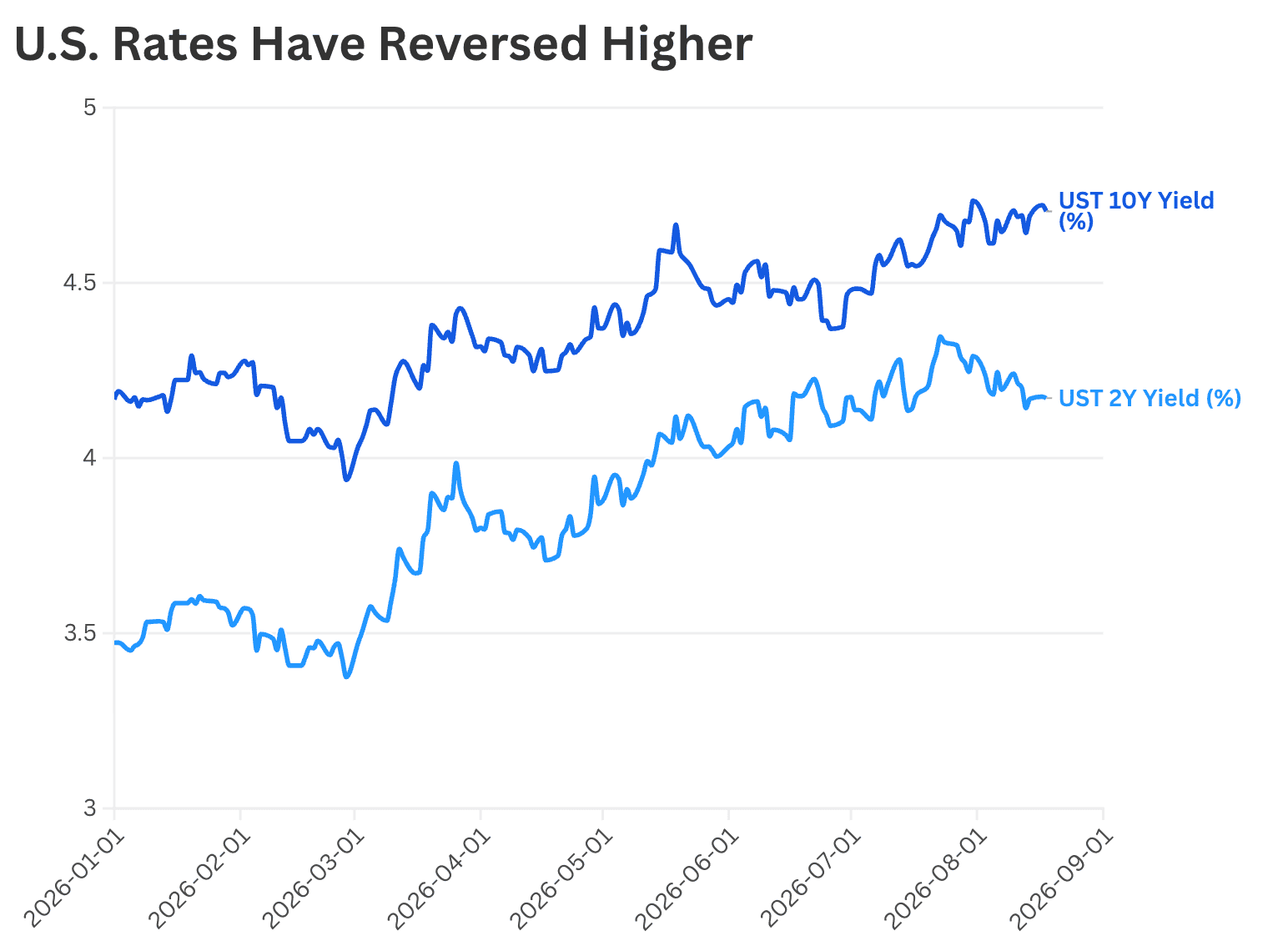
Elevated U.S. interest rates are keeping yields across the GCC sukuk market near levels rarely available during the past decade. Nukoud data show the 10-year U.S. Treasury yield at 4.69% on August 19, 2026, up 52 basis points from 4.17% at the start of the year and 75 basis points above its February 27 low of 3.94%.
The repricing extends across the Treasury curve. The two-year yield rose about 68 basis points year to date to 4.16%, while the three-month yield increased about 16 basis points to 3.79%. Higher benchmark rates have lifted the starting yields available on dollar-denominated GCC sukuk even as regional credit spreads have retreated from their conflict-driven highs.
That relationship is particularly relevant in the Gulf. Dollar-denominated sukuk are priced against U.S. benchmark rates, while the currency pegs maintained by Saudi Arabia, the UAE and several other GCC economies transmit U.S. monetary conditions into local funding markets. The result is a sukuk market where yields around 5% increasingly reflect high underlying interest rates alongside relatively contained investment-grade credit spreads, rather than a broad deterioration in GCC credit quality.
Treasury Yields Are Driving Much of the Sukuk Yield
Fitch reported that the spread between the S&P GCC Sukuk Index and U.S. Treasuries widened to around 100 basis points on March 23, compared with roughly 70 basis points before the conflict on February 27. By June 15, however, the spread had narrowed to 67 basis points, close to its pre-conflict level.
GCC sukuk yields did not return to February levels. The index still yielded 4.94% on June 15, 51 basis points above its February 27 level.
Credit spreads measure the additional compensation investors demand above the benchmark rate for risks including credit and liquidity. If spreads normalize while absolute sukuk yields remain elevated, much of the remaining pressure is coming from the underlying risk-free curve rather than a persistent repricing of GCC credit.
Nukoud's data reinforce that point. The 10-year Treasury fell to 3.94% on February 27, before climbing to 4.73% on July 31 and ending at 4.69% on August 19.
A 5.5% Sukuk Yield Does Not Mean a 5.5% Return
The Irish-domiciled iShares $ Sukuk UCITS ETF, SKUK, held 221 securities and had a 5.55% weighted-average yield to maturity as of August 6, according to BlackRock. Its effective duration was 4.08 years, trailing distribution yield was 4.82% and total expense ratio was 0.40%.
Saudi exposure is substantial. KSA Sukuk Ltd represented 6.59% of the portfolio on August 11, while Saudi Electricity Sukuk Programme accounted for another 4.98%.
Yet SKUK's NAV total return was only 0.28% year to date through August 7, even while its portfolio YTM stood at 5.54%.
Higher market yields push existing bond and sukuk prices lower, which can offset coupon income.
Duration Determines How Much Higher Rates Hurt
SKUK's effective duration of roughly four years provides a useful illustration.
As a first-order approximation, a portfolio with four years of duration would lose around 4% in price if its yield rose suddenly by 100 basis points, before accounting for coupon income, convexity or changes in credit spreads. A 50-basis-point increase would imply roughly a 2% price effect.
The relationship works in reverse. Falling yields can produce capital gains alongside the income generated by the sukuk portfolio.
That makes today's 5%-plus YTM different from a guaranteed 5% annual return. Investors are being paid more income, but they remain exposed to the direction of rates.
GCC Sukuk Yields Compared With U.S. Treasuries
Sources: Nukoud Treasury dataset, U.S. Treasury, S&P/Fitch, BlackRock, Lunate and Saudi Exchange. Figures are the latest observations available for each instrument within the stated period and are not same-day observations.
Saudi Sukuk Show the Same Rate Pressure
A Saudi government SAR sukuk listed on Tadawul, maturing in January 2026 under security 5379, recorded a 5.60% yield on August 3, according to Saudi Exchange data. The security carried a 5.69% coupon.
Corporate credit can offer considerably more. Cenomi Centers' sukuk due in 2031 traded at a yield of about 8.24% on August 6, with an 8.50% coupon. That additional yield reflects risks beyond Treasury duration, including corporate credit and liquidity.
This is where investors need to separate rates from spreads. A 5%-plus sovereign or diversified investment-grade sukuk yield and an 8%-plus corporate sukuk yield are not interchangeable simply because both are Shariah-compliant fixed-income securities.
Higher Rates also Improve the Starting Point
The UAE's inaugural sovereign Retail T-Sukuk illustrates the change in the savings market. Launched in June, the two-year government-backed security offered residents and citizens a 4.30% annual profit rate, with an AED1,000 minimum subscription. Saudi Arabia's June Sah savings sukuk offered citizens 4.60% for one year.
Meanwhile, Saudi Arabia allocated SAR10.576 billion through its institutional SAR-denominated government sukuk programme in June, across maturities running from 2029 to 2041.
Higher rates therefore create opposing effects: existing longer-duration securities face valuation pressure, while new issues and reinvested cash can lock in higher prospective income.
The Next Sukuk Move May be Made in Washington
The GCC-specific risk premium has already demonstrated that it can move independently of Treasury yields. Geopolitical stress pushed spreads wider in March before they subsequently compressed. Treasury yields, meanwhile, remained elevated.
At a 4.69% U.S. 10-year Treasury yield, investment-grade sukuk do not need unusually wide credit spreads to approach or exceed 5%. If Treasury yields decline, medium-duration sukuk could receive support from both income and rising prices. If U.S. yields move higher again, today's higher starting income provides a larger cushion, but duration remains capable of eroding part of that return.
For GCC investors, the attraction of today's sukuk market is therefore measurable rather than simply qualitative: starting yields are higher, while the price paid for that income is continued exposure to one of the most consequential numbers in global markets, the U.S. Treasury yield.