GraniteShares launched its 4x Long Crude Oil Daily ETP (4OIL) on the London Stock Exchange on October 15, 2026, introducing a product designed to deliver four times the daily return of an existing oil fund.
However, despite its name, the ETP does not directly track Brent crude, spot oil prices or physical barrels. Instead, it follows a leveraged index linked to the United States Oil Fund (USO), which obtains its own oil exposure primarily through futures contracts.
That introduces several layers between movements in crude oil prices and the returns ultimately experienced by investors.
How the Four-Times Oil ETP Actually Works
The product tracks the Solactive Daily Leveraged 4x Long Crude Oil Index, which targets four times USO's daily performance before fees and adjustments.
USO itself is designed to reflect movements in US West Texas Intermediate (WTI) crude oil through futures and related instruments. Because futures contracts expire, the fund must periodically adjust its holdings, exposing investors to differences between contract prices and spot oil movements.
GraniteShares then adds daily leverage through a synthetic structure involving a collateralized swap with Natixis.
Inside the New GraniteShares Oil ETP
Sources: GraniteShares and USCF Investments.
Why Oil Prices and ETP Returns Can Diverge
The product's leverage resets daily, meaning a 1% increase in USO targets approximately a 4% increase in the ETP. A 1% decline similarly targets a 4% loss, before fees and other adjustments.
Over multiple sessions, however, compounding can produce unexpected results.
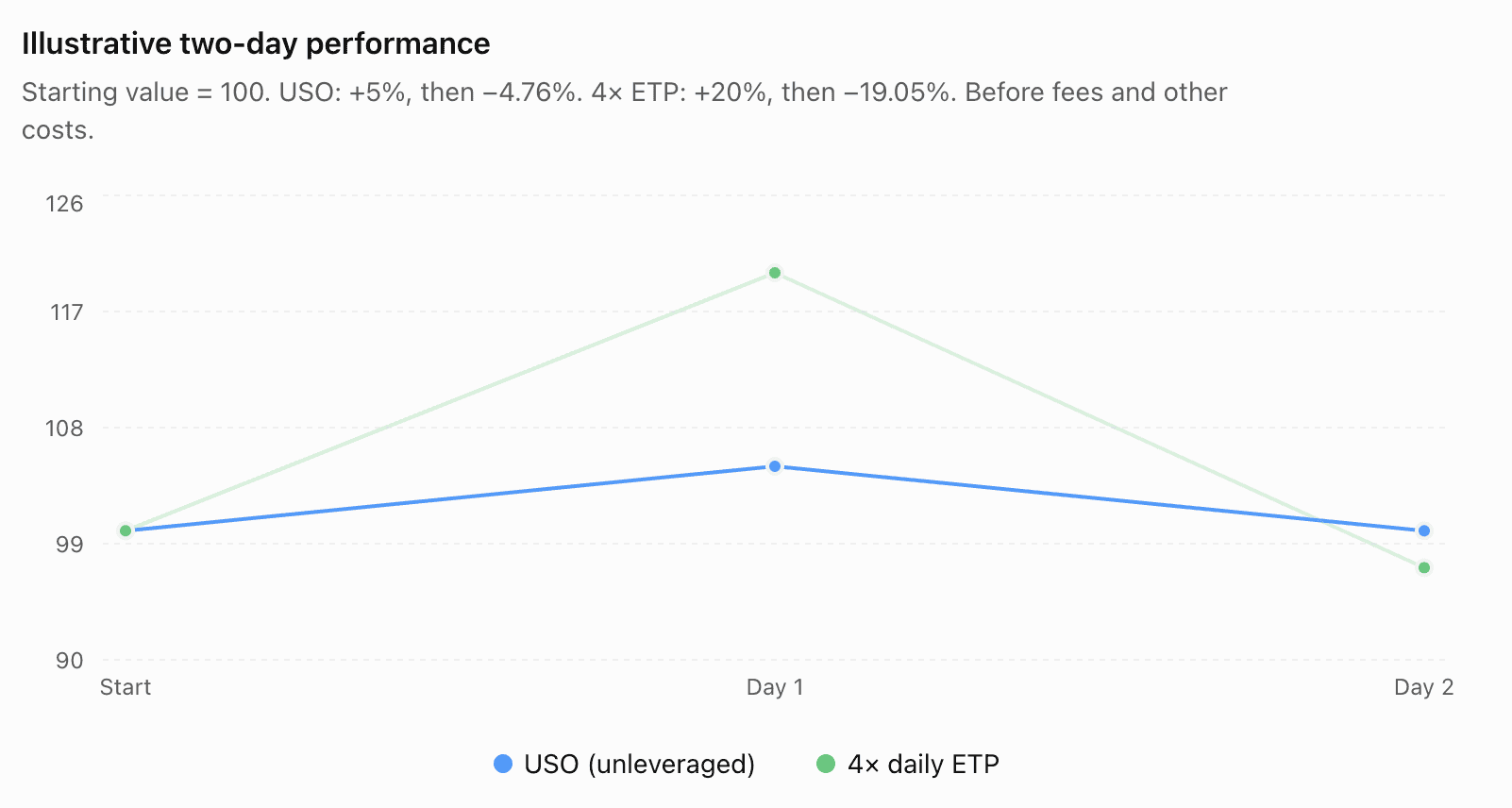
Consider a hypothetical two-day period in which USO rises 5%, then falls approximately 4.76%, returning to its starting value.
A four-times-leveraged product would initially gain 20%, then lose approximately 19.05% from its higher value. The resulting two-day loss would be approximately 2.86%, despite USO finishing unchanged.
This is one illustration of how volatility can erode leveraged returns. In sustained trends, daily compounding can also amplify gains.
Investors face an additional source of divergence through USO's futures exposure. Rolling futures contracts can create costs or benefits depending on the shape of the oil futures curve.
The Cost of Four-Times Exposure
Leverage introduces financing and transaction costs beyond those normally associated with an unleveraged investment.
GraniteShares publishes an annual management fee of 1.25%, but its broader cost disclosures also reflect the expenses associated with maintaining leveraged exposure.
A quoted total daily ongoing cost of 0.0399% would translate to approximately 14.6% over 365 days by simple multiplication. That is an arithmetic comparison, not an annual expense ratio or a forecast of actual investor costs.
Investors must also account for trading spreads, futures-related effects and the potential for substantial capital losses.
GraniteShares describes the product as suitable for experienced investors who understand leverage and monitor positions frequently. Its collateral arrangements mitigate certain counterparty risks but do not eliminate the possibility of losing the entire investment.
What GCC Investors Should Know
For investors in oil-producing GCC economies, a bullish view on crude prices does not necessarily translate into equivalent gains from a leveraged oil ETP.
Regional oil benchmarks, including Brent, can move differently from the WTI-linked futures exposure underlying USO. Currency movements, daily compounding and product costs introduce further differences.
The launch also reflects the wider expansion of leveraged exchange-traded products, a trend examined in Nukoud's analysis of the global leveraged ETF market.
Investors can explore the broader risks in Nukoud's guide to leveraged ETFs and compare available products using its leveraged ETF database.