
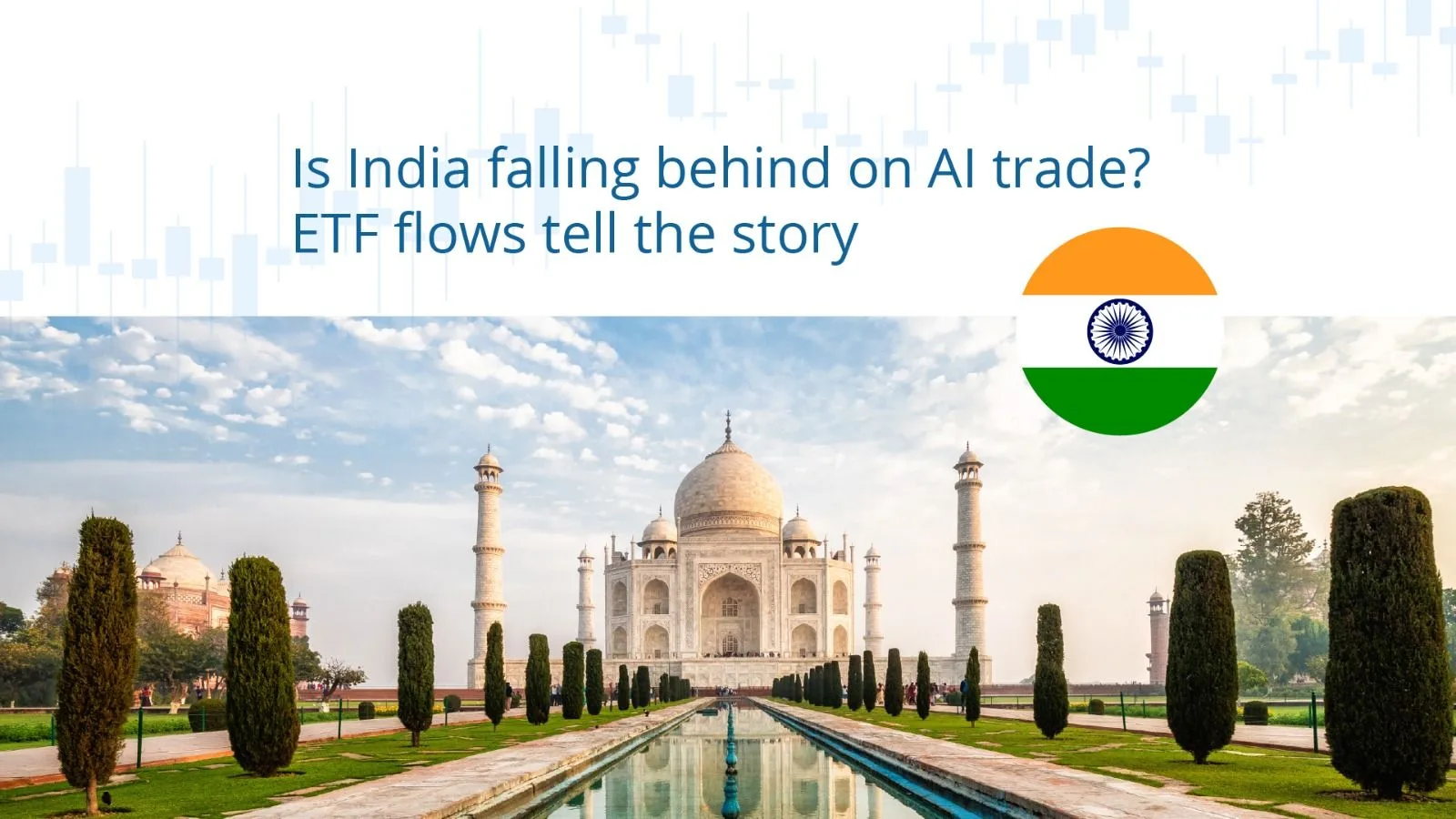
Foreign capital is rotating from India to Korea and Taiwan to capture the AI hardware supercycle. We examine the data, the structural drivers, and what GCC investors should consider.
The Capital Rotation in Context
For much of the past decade, India was the consensus overweight in emerging-market portfolios. GDP growth consistently above 7%, a deep consumer market, and a large English-speaking technology workforce made it the preferred destination for long-term capital. That consensus is now being tested by a sharper, more concentrated trade: AI hardware.
Since April 2025, a decisive rotation has taken place, with foreign capital moving toward South Korea and Taiwan to gain exposure to the AI semiconductor supercycle, largely at India's expense. By early May 2026, foreign institutional investors had pulled approximately ₹1.92 lakh crore (roughly $23 billion) from Indian equities in 2026 alone, a figure that already exceeds the full-year record set in 2025.
"The AI trade is driving the rotation." Two companies in South Korea, Samsung and SK Hynix, and one in Taiwan, TSMC, are attracting the lion's share of global technology inflows, according to Dr. VK Vijayakumar, Chief Investment Strategist at Geojit Investments.
Why Korea and Taiwan Are Winning the AI Race
The current AI investment thesis in equity markets is centred on hardware: the chips, memory, and foundry capacity needed to run large-scale AI workloads. Taiwan and South Korea sit at the core of this supply chain. Taiwan's Taiex index has repeatedly posted new records in 2026, powered by TSMC's dominant position in advanced chip manufacturing. South Korea's Kospi surged more than 80% in 2025, driven by Samsung and SK Hynix, the principal suppliers of high-bandwidth memory that AI data centres consume.
Goldman Sachs estimates that Taiwan's equity market is "well over 80%" exposed to AI-related revenue streams, while South Korea sits around 60%. The earnings divergence is stark: Jefferies estimates Samsung and SK Hynix will earn combined profits of approximately $307 billion in 2026, nearly three times the projected $102 billion for the entire Nifty 50 universe.
India's Structural Strengths and the AI Gap
It is critical to separate India's equity market performance from its macroeconomic fundamentals. The domestic growth story remains sound: GDP expanded at 7.8% in Q3 FY2026, GST collections crossed ₹2 trillion in March 2026 for the first time since mid-2025, and automobile volumes grew over 20% across segments. India's long-term consumer and infrastructure case has not changed.
The challenge is structural but narrower: India's technology sector is built around IT services, the cost-efficient delivery of software development, testing, and business process management for global enterprises. This model faces a dual headwind. First, global capital is chasing AI hardware exposure that India simply cannot offer at scale. Second, generative AI is beginning to automate the very services India's IT sector delivers.
ICICI Direct analysis estimates that roughly 30% of India's $280 billion IT services industry faces revenue risk from generative AI-led automation, with peak disruption projected during FY2026-FY2028, followed by recovery from FY2029 onward. Indian IT firms are transitioning from labour-led delivery toward AI-augmented, outcome-based models, but this shift takes time to reflect in earnings.
Is the Rotation Structural or Cyclical?
Recent data suggests the AI trade rotation may be approaching a natural pause. South Korea saw a historic foreign outflow of $1.3 billion in the most recent weekly reading, while Taiwan inflows slowed sharply to $160 million against a six-month weekly average of $820 million. India's outflows have also moderated from a record $3.5 billion in March 2026 to $1.5 billion in April and approximately $702 million in May so far. Fund flows have stabilised over the last two weeks after 11 consecutive weeks of outflows totalling around $6 billion.
Goldman Sachs estimates that with approximately $22 billion already pulled from Indian equities year-to-date, the remaining downside risk from incremental foreign selling is limited to $4-5 billion. Passive ETF allocations to India have not reversed, with ETF inflows partially offsetting long-only fund redemptions.
The rotation into Korea and Taiwan reflects a concentrated positioning trade, not a structural rejection of India. India's economic fundamentals, including growth, consumption, and demographic potential, remain broadly intact.
Implications for GCC Investors
GCC investors accessing global emerging-market exposure through listed ETFs, whether via Tadawul, the Abu Dhabi Securities Exchange, or international platforms, face a concrete portfolio construction question: how should India, Taiwan, and Korea be weighted given current dynamics?
Three Portfolio Scenarios for GCC Investors
Scenario 1: Hold India, Reduce Overweight. Investors who have held India as a strategic allocation since pre-2025 may consider trimming toward benchmark weight (MSCI EM India weight is approximately 18-20%) while the AI rotation and valuation compression play out. India's 12-month forward P/E of approximately 24x remains elevated relative to EM peers, though it has corrected from 2024 peaks.
Scenario 2: Add AI Hardware Exposure. Investors seeking to participate in the AI hardware cycle without single-stock risk can access it through diversified semiconductor ETFs (SMH, SOXX) or Taiwan-specific instruments (EWT). GCC sovereign wealth funds, including Mubadala and PI, F have signalled increased interest in AI infrastructure themes. Globally listed semiconductor ETFs offer a liquid proxy for the same exposure.
Scenario 3: Broad EM, Let Allocation Do the Work. For investors who prefer not to make country-level tactical calls, a diversified EM ETF (IEMG) returned 16.77% YTD through May 26, 2026, allowing Taiwan's strength to offset India's weakness within a single wrapper. This is the simplest implementation for GCC investors looking to build a core emerging-market position.
Medium-Term Outlook
India's equity market underperformance is not a verdict on the country's long-term trajectory. J.P. Morgan Private Bank identifies India as one of its top implementation ideas outside the U.S. for 2026, noting compelling cyclical tailwinds at current entry valuations. The medium-term risk is structural: if India's technology sector cannot navigate the transition from IT services toward AI-native delivery models, the premium it has historically commanded in EM portfolios will compress further. This transition is measured in years, not quarters, with analysts projecting recovery from FY2029 onward.
For GCC investors, India remains a long-term diversifier with genuine structural upside. The current flow dislocation driven by a concentrated global trade in AI hardware is creating a potential re-entry opportunity, but one that requires a minimum 18-24 month investment horizon to realise.
Key Takeaway:
India's outflows reflect a targeted AI hardware trade, not a rejection of its economy. The rotation to Korea and Taiwan is showing early signs of exhaustion. GCC investors should maintain strategic India exposure, selectively add AI hardware ETF positions, and monitor ETF inflow stabilisation as a re-entry signal for India-specific allocations.