
Shariah-compliant ETFs held $17.9 billion at the end of September 2026, up 52% in a year and nearly 30 times the $0.6 billion they managed at the end of 2019.
The growth is no longer a US-and-London story: Turkey, Saudi Arabia and Indonesia now hold a third of the assets and supply most of the new listings, while sukuk and gold ETFs have given Islamic investors more options beyond screened equities.
What This Means for GCC Investors
In 2021 a Shariah-conscious investor had 32 Islamic ETFs to pick from worldwide, almost all equity index trackers. Today there are 82, including six sukuk funds and a dozen physically backed gold products, and 14 of them listed in the first nine months of 2026 alone.
Nukoud's GCC ETF Market Monitor for H1 2026 previously documented the expansion of Shariah-compliant products across regional exchanges.
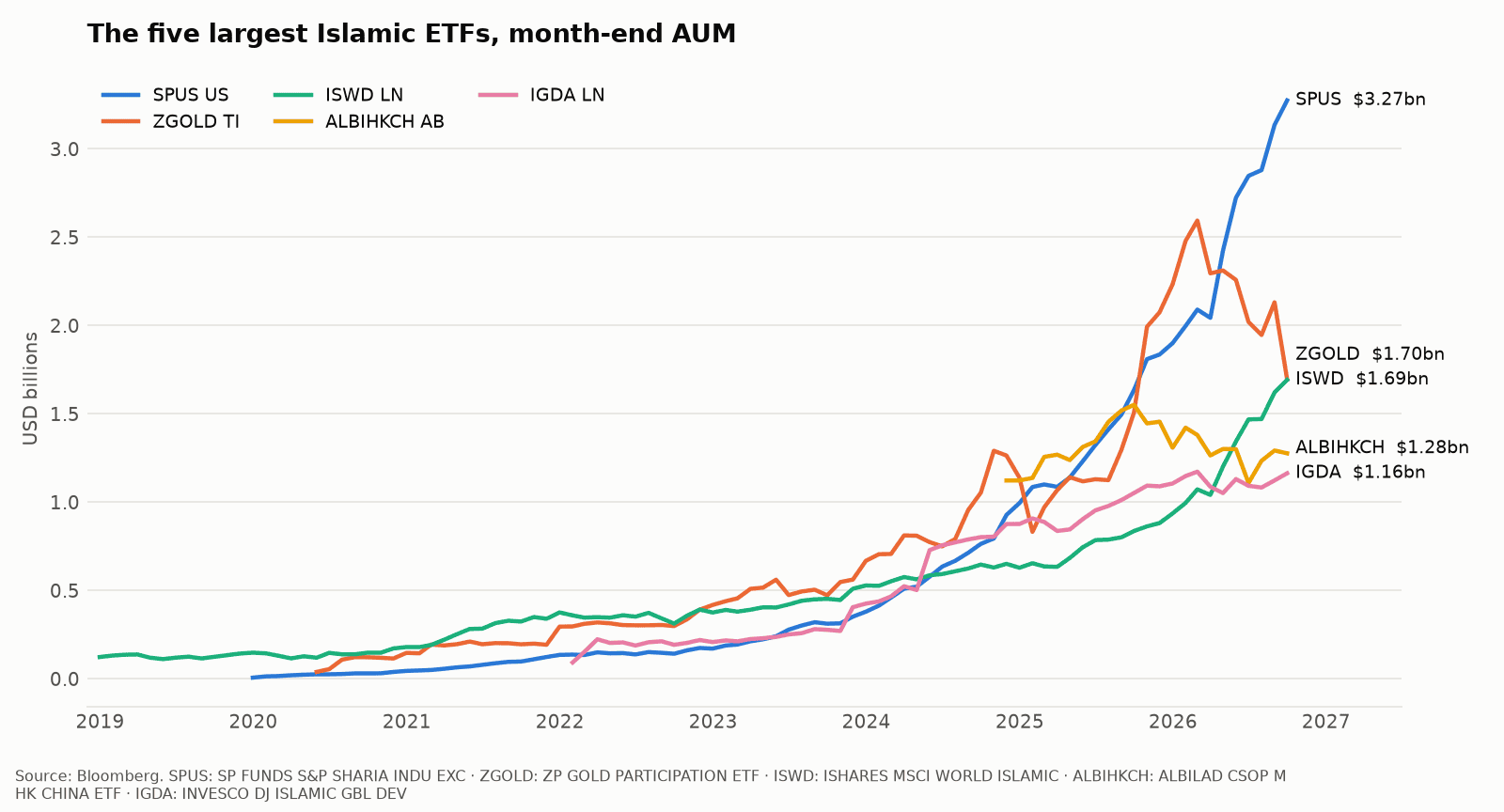
On Tadawul, Albilad Capital runs the deepest shelf. The Albilad CSOP MSCI Hong Kong China Equity ETF (9410) is the largest GCC-listed Islamic ETF at $1.28 billion less than two years after listing, alongside the Albilad MSCI Saudi Growth ETF (9408), Albilad Gold ETF (9405) and Albilad Saudi Sovereign Sukuk ETF (9403).
SAB Invest Saudi Quant ETF (9402) holds $101 million, and Al Rajhi Capital entered in August 2026 with the Al Rajhi MSCI Saudi Equity ETF (9413).
On ADX, Lunate's Shariah range covers the UAE (UAEA), Saudi Arabia (SAUDIA), India (INDI), Kuwait (KWTI) and Turkey (TURKI), plus a global sukuk ETF (SUKUK). In Doha, Al Rayan Qatar ETF (QATR) holds $110 million.
For global equity exposure the liquidity still sits in London. iShares MSCI World Islamic UCITS ETF (ISWD) at $1.69 billion and Invesco Dow Jones Islamic Global Developed Markets UCITS ETF (IGDA) at $1.16 billion are the UCITS core holdings, charging 0.30% to 0.40% against a 0.55% category median.
US-listed SP Funds S&P 500 Sharia Industry Exclusions ETF (SPUS) is the largest Islamic ETF anywhere at $3.27 billion, but GCC buyers face 30% US dividend withholding and US estate-tax exposure that Irish-domiciled funds avoid
The numbers
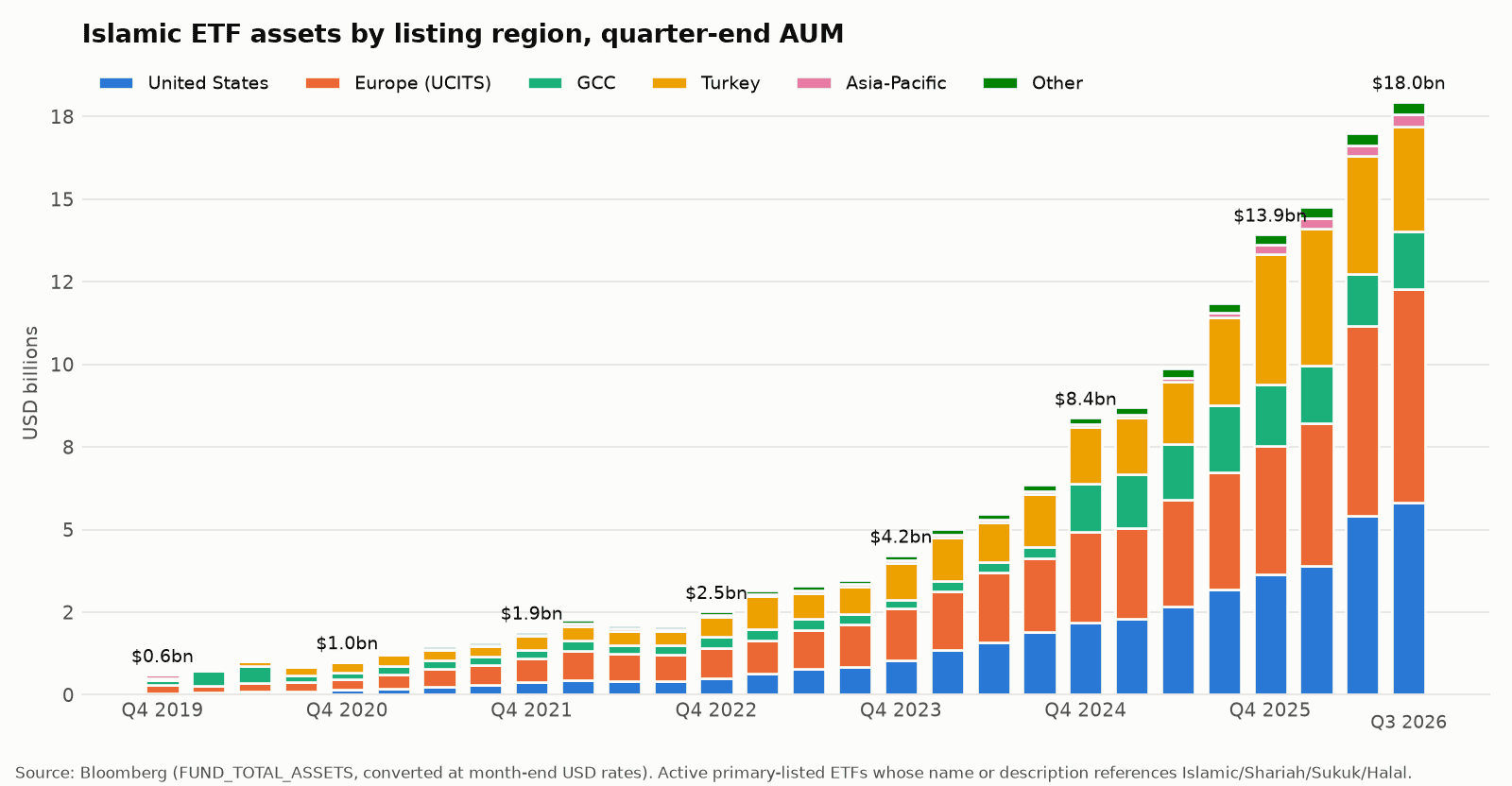
USD billions, quarter-end AUM converted at month-end rates. Source: Bloomberg.
Assets have more than doubled every two years since 2019, a compound growth rate of 65% a year. Europe remains the largest listing region, ahead of the US, on the strength of the HSBC, Invesco and Wahed UCITS launches. The GCC line flattened in 2026 after tripling across 2024 and 2025; part of that is Saudi equity performance, and part is a data gap, since the Albilad MSCI Saudi Equity ETF (9412), listed in October 2025, and several ADX-listed Lunate funds have not reported assets to Bloomberg since mid-2025.
Who runs the money
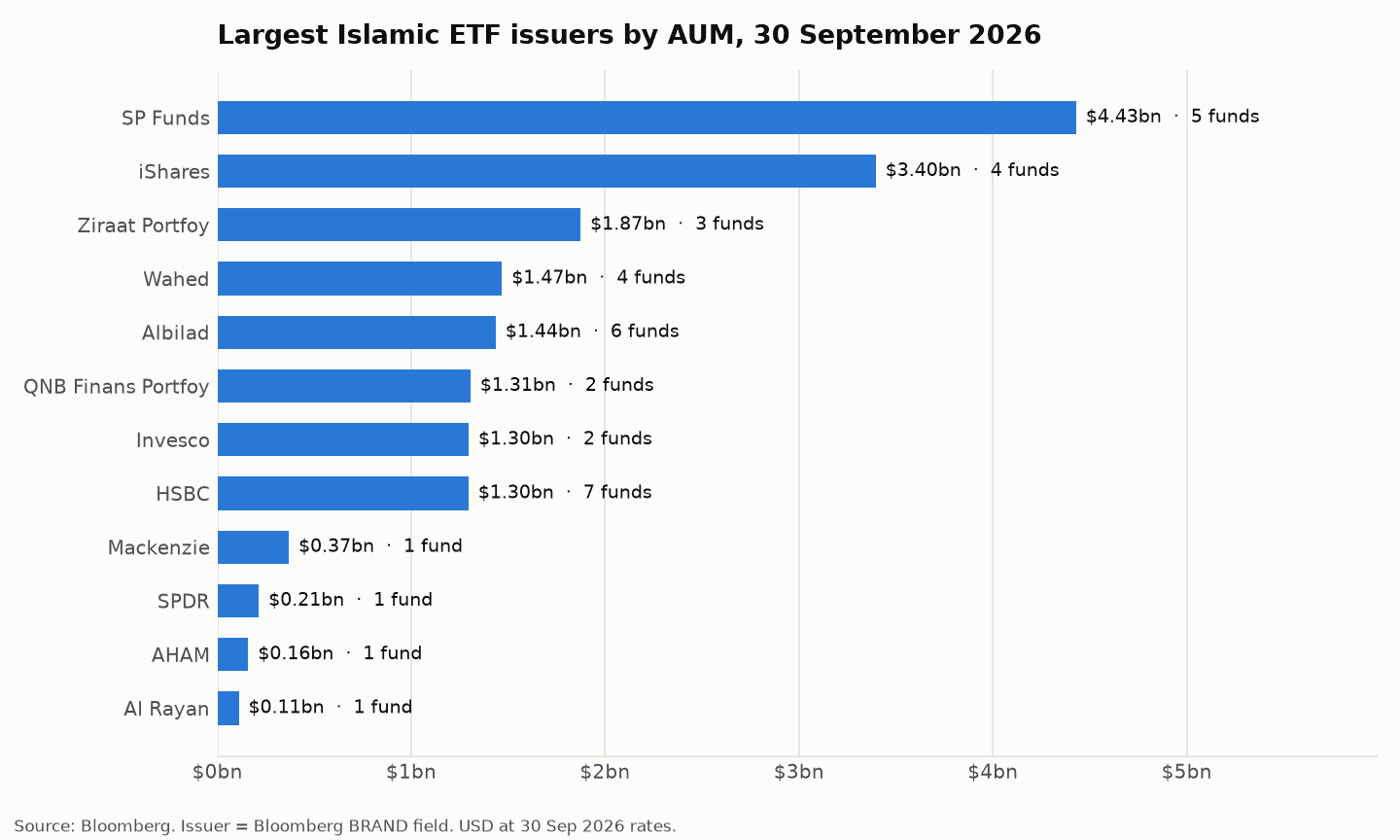
Eight issuers control 92% of the assets. The global houses, iShares, Invesco and HSBC, took the index-tracking route and compete on fee. The specialists built their books around one flagship each: SPUS, Wahed FTSE USA Shariah ETF (HLAL), the Albilad China fund, and ZP Gold Participation ETF (ZGOLD), which at $1.70 billion is the world's second-largest Islamic ETF and a pure gold vehicle.
Four Drivers Behind the Growth
Every major index provider now publishes Islamic versions of its benchmarks using a two-step filter.
Business screens exclude conventional banking and insurance, alcohol, tobacco, gambling, pork, adult entertainment and weapons. Financial screens then remove companies whose debt, interest-bearing cash or receivables exceed roughly a third of market capitalisation, the AAOIFI-derived thresholds that S&P Dow Jones, MSCI and FTSE Russell apply with variations.
Managers purify residual impermissible income through charity and disclose the ratio. Because the screens are published and audited by a Shariah board, an ETF can track a Shariah index without each investor needing their own scholar.
However, screening methodologies and fund structures still require examination. Nukoud's Beyond the Label: Due Diligence for Shariah-Compliant ETFs coverage explores the additional considerations involved in assessing Islamic investment products.
Sukuk ETFs Created the Fixed-Income Sleeve
Until 2023 no diversified sukuk portfolio existed in ETF form. HSBC Global Sukuk UCITS ETF (HBKU) launched that September and holds $581 million; iShares USD Sukuk UCITS ETF (SKUK) followed in January 2024 at $202 million and SPDR J.P. Morgan Saudi Arabia Aggregate Bond UCITS ETF (KSAB) in December 2024 at $214 million.
Sukuk ETFs now hold $1.5 billion, so a fully Shariah-compliant multi-asset portfolio can be built from listed funds for the first time.
Nukoud's sukuk ETF database allows investors to compare available products by fees, fund size and market exposure.
Gold Went Shariah-Compliant
The 2016 AAOIFI Shariah gold standard cleared the way for physically backed gold funds.
Gold is now $3.2 billion, or 18%, of Islamic ETF assets, led by Ziraat and QNB Finans in Istanbul, where lira depreciation drives demand, and by the Albilad Gold ETF on Tadawul.
Indonesia listed six Shariah gold ETFs in August and September 2026, which is why Asia-Pacific tops the 2026 launch chart.
The growing selection also introduces differences in legal structure, custody and physical backing. Nukoud's guide to eight ways to invest through gold ETFs examines how these products differ, including the requirements for Shariah-compliant gold exposure.
Saudi Arabia Built a Local ETF Market
Tadawul-listed Islamic ETFs went from one fund in 2019 to nine today with $1.6 billion in assets, and the Albilad China fund shows the regulatory framework now accommodates ETFs holding foreign assets.
The expansion is part of a broader shift in regional ETF development, with local issuers offering investors access to domestic equities, international markets, commodities and Islamic fixed income.
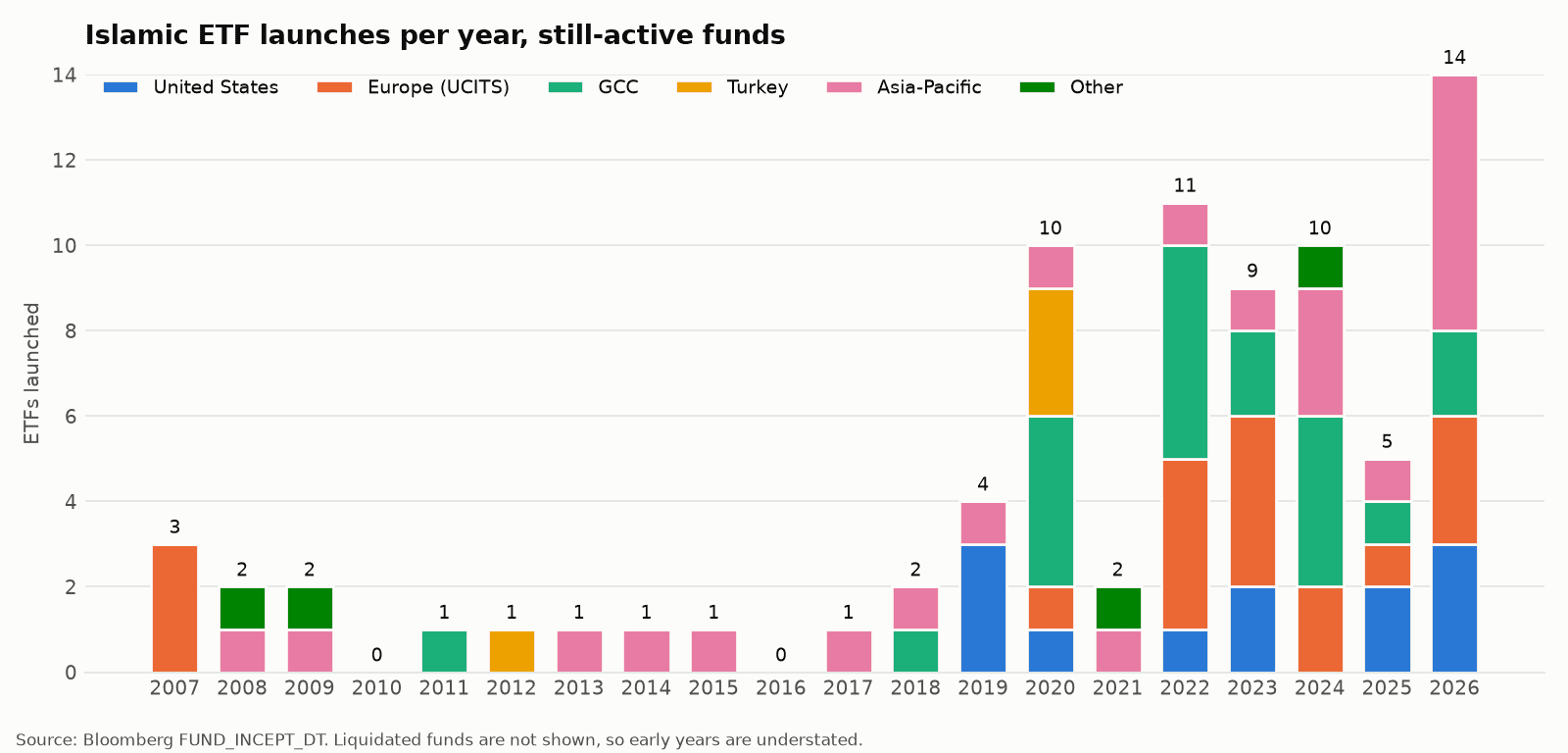
Saudi Arabia built a local ETF market. Tadawul-listed Islamic ETFs went from one fund in 2019 to nine today with $1.6 billion in assets, and the Albilad China fund shows the regulatory framework now accommodates ETFs holding foreign assets.
What Is Still Missing
The category is concentrated and expensive. SPUS alone is 18% of all Islamic ETF assets. The median expense ratio is 0.55%, against roughly 0.20% for mainstream global equity trackers, and the Turkish gold funds charge 3.6% to 4.4%.
Only 15 of the 82 funds exceed $250 million and 14 report no assets to Bloomberg at all, so secondary liquidity outside the top names is thin.
Investors comparing funds can use Nukoud's ETF screener to examine trading activity, expenses, holdings and performance before selecting products.
The next test is whether the 2026 launch wave gathers assets or becomes a graveyard. Watch the Al Rajhi MSCI Saudi Equity ETF (9413) and Lunate's GCC Dividend ETF (GCCDIV) through their first year, and watch for a second sukuk ETF listing in the GCC: either would put the regional share of Islamic ETF assets back on an upward path.